
How we investBuilding net worth
Why invest through a fund of funds instead of going direct to the sponsor?
Three things you cannot buy with one check.
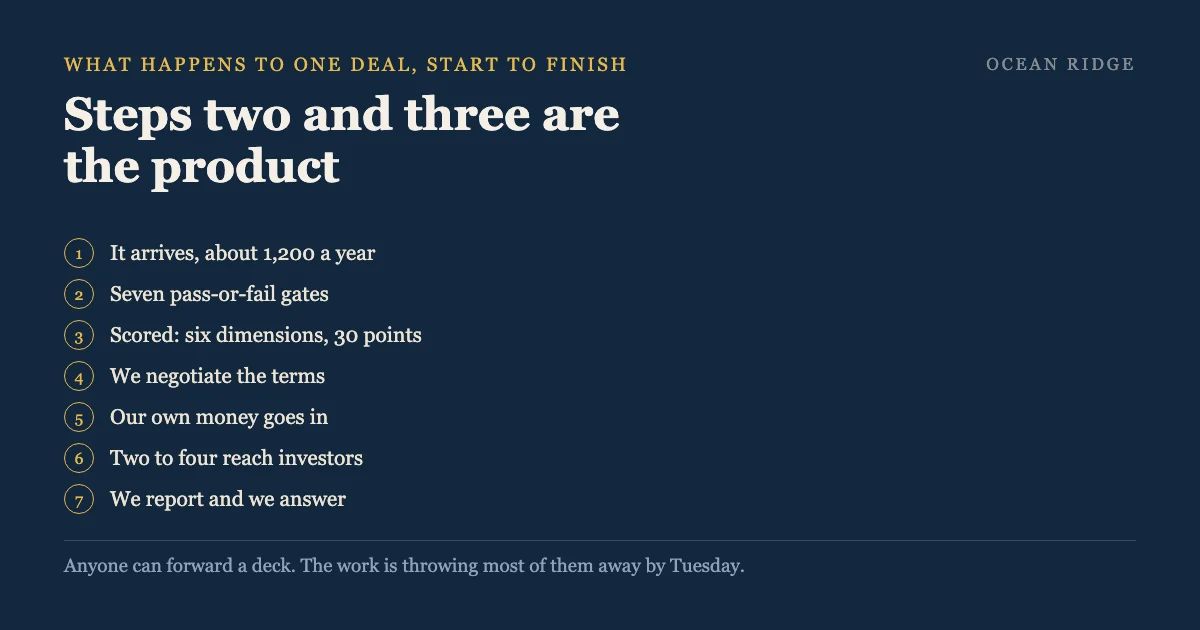
We are investors, not a sponsor, not a broker and not an adviser. We read a large volume of deals each year, commit to two to four, negotiate the terms, put our own money in, and then open the door to people we know. We do not operate the properties and we do not place anybody else’s deals.
For educational purposes only. Nothing on this page is investment, legal or tax advice, and nothing here is an offer to buy or sell any security. Ocean Ridge Capital Partners, LLC is not a registered investment adviser, broker-dealer, law firm or accounting firm.
The question underneath is which side of the table we sit on. In private real estate that matters more than the job title, because the person showing you a deal is either paid to place it or invested in it, and those two people give different advice. So the useful version of the question is: where does your money come from, and does it arrive whether or not this deal works?
Steps two and three are the whole product. Anyone can forward a deck.
Most people assume step four is the product, and it is not. By the time we are negotiating the decision has already been made: better terms improve a deal we had decided to do, and they cannot rescue one we should have declined at step two.
| Not this | Because |
|---|---|
| A sponsor | We do not buy, manage or operate the property. The sponsor does, and we underwrite the sponsor. |
| A broker | Nobody pays us to place their deal. Our money goes in beside yours, which is the opposite incentive. |
| An investment adviser | We do not manage your portfolio or tell you what to hold. The federal definition sits in 15 U.S.C. 80b-2, and the exemptions for private fund managers in 15 U.S.C. 80b-3. |
| A lender | There is no Ocean Ridge credit vehicle today. Private credit is something we study and screen, not something we sell. |
Each of those is a different regulatory regime, a different fee model and a different reason to call you, so pinning down which one you are talking to is the first question an investor should ask of anybody.
Private offerings used to be unmentionable. A sponsor relying on Rule 506(b) cannot advertise at all, which is why most of this industry is invisible. Rule 506(c) allows general solicitation, and in exchange the sponsor must take reasonable steps to verify that every purchaser is accredited.
That trade is why these pages exist. We can write publicly about what we buy and how we decide. You will be asked for verification at subscription rather than taken at your word. Nothing on this site is an offer of anything, and an offer, when it comes, arrives as documents.
One thing this does not change: nothing on these pages is an offer, and nothing here is advice about your own situation. We write them so the reading is done before the call rather than during it. If something is open when you get in touch, it arrives as documents, with the verification step in front of it, and you decide from there.
Our view is that the edge in this business is in what you decline. Anybody can assemble a pipeline; the work is throwing most of it away quickly enough to spend real time on the rest. That is why the gates run before the diligence rather than after it, and why the number we are proudest of is how few deals get through.
We also think the alignment question answers itself if you look at where the money comes from. We are not paid to place a deal, so a bad deal costs us the same way it costs you. That is a simpler arrangement than any disclosure can describe, and it is the one we would want as investors.
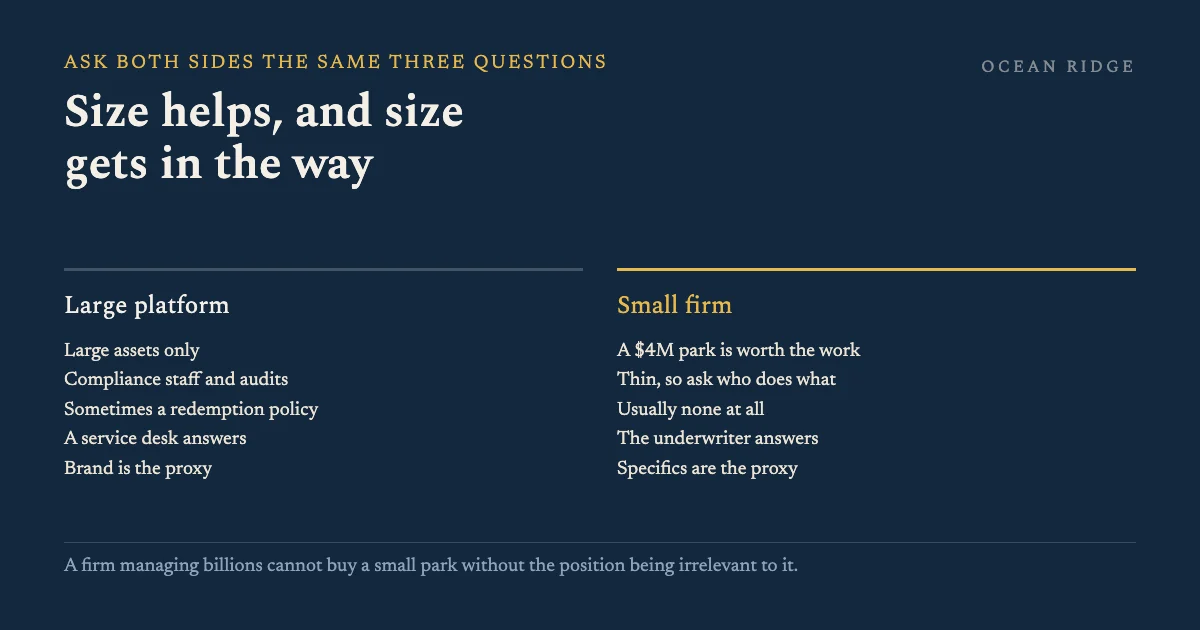
The size of the firm is part of the method rather than a stage we are trying to leave. Small capital can buy a four million dollar park. Large capital cannot be bothered. We would rather stay in the part of the market where that is still true.
This is a description of Ocean Ridge and not a template for the industry. Plenty of good firms are sponsors, and operating the asset yourself is a legitimate model with its own advantages. Plenty of others are placement agents, paid a fee to distribute a deal, which is lawful and disclosed. What matters is not which model somebody uses, but whether they tell you which one it is before you ask.
No. The sponsor and their property manager run the asset day to day. Our work is deciding which sponsors to back, on what terms, and watching the numbers afterwards.
No. We are not paid to distribute anybody else’s offering. Our money is invested beside yours on the same terms, so a poor outcome reaches us the same way.
We are not a registered investment adviser or broker-dealer. Private fund managers below certain thresholds operate under exemptions written into the Advisers Act, which is the ordinary arrangement for a firm this size.
Two to four. The rest of the year is spent reading the ones we do not do, which is less glamorous and more of the job than most people expect.
If you are weighing a deal this year, book an investor strategy call.
Published · Last reviewed
Next step
Not ready to talk? Take the investor quiz and we will send what fits.
Keep reading
How we investBuilding net worth
Three things you cannot buy with one check.
How we investBuilding net worth
Do not trust either on the strength of the name.