
How we investBuilding net worth
Why invest through a fund of funds instead of going direct to the sponsor?
Three things you cannot buy with one check.
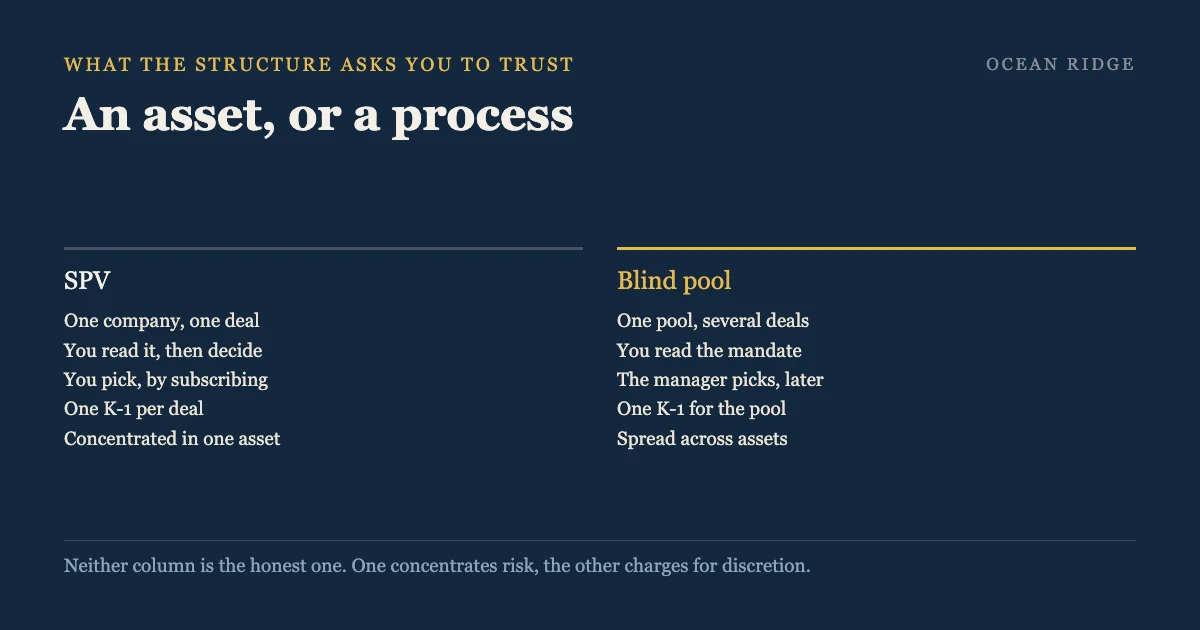
An SPV is one limited liability company that holds one deal. You read that deal, then decide. A blind pool takes the money first and buys later, so you are judging a manager rather than an asset. Both are legitimate structures. Only one of them lets you say no to a specific property.
For educational purposes only. Nothing on this page is investment, legal or tax advice, and nothing here is an offer to buy or sell any security. Ocean Ridge Capital Partners, LLC is not a registered investment adviser, broker-dealer, law firm or accounting firm.
The question underneath is how much trust the structure is asking of you. Every private deal asks for some. An SPV asks you to trust a property, a sponsor and a set of numbers you can read tonight. A blind pool asks you to trust a process that has not run yet, for assets nobody has identified, on terms that get negotiated after your wire clears. Those are different questions, and they deserve different answers.
| Question | SPV | Blind-pool fund |
|---|---|---|
| What you own | A membership interest in one company holding one asset | An interest in a pool that will hold several |
| What you can read before wiring | The asset, the debt, the rent roll, the sponsor | The mandate, the manager and the fee terms |
| Who picks the asset | You, by subscribing or not | The manager, later |
| If you dislike the next deal | You do not fund it | Your capital is already committed |
| Year-end paperwork | One K-1 per deal | One K-1 for the pool |
Neither column is the honest one. An SPV concentrates everything into a single asset, so one bad roof, one bad market or one bad operator is the whole result. A pool spreads that out and charges you a layer of discretion for doing it.
One question settles it faster than any comparison. Ask what you are being shown before the wire. If the answer is a property, you are reading a deal. If the answer is a strategy, you are reading a manager. Both can be worth owning, and they are not the same purchase.
Three reasons, and only one of them is about you.
That last one matters more than it sounds. In a pool, a weak deal can hide behind a strong one for years. In an SPV it cannot hide anywhere.
Several things, and they are real.
The condition attached is that you are buying a mandate and a record rather than a property. So the diligence moves: how tightly is the mandate written, what has this manager done through a downturn, what can they do without asking you, and what are you told afterwards. A sponsor relying on Rule 502(b) has to furnish set information to non-accredited purchasers who ask for it. Past that, you get what the documents promise and no more. So read the reporting clause as carefully as the fee clause.
There is a middle path worth knowing about. Some managers raise a pool with a stated pipeline. Others give investors the right to opt out of a named deal. Both reduce the blindness. Both also slow the manager down, which is the thing the pool was for in the first place. Ask which one you are being offered, because the label on the document will not tell you.
We use single-deal vehicles because we want the investor to be able to say no to a particular property. The moment capital is committed in advance, the question changes from "is this a good deal" to "is this a good manager", and we would rather be judged on deals than on adjectives.
It also keeps us honest in a way a pool does not. Every deal has to be sold on its own merits to people who have already seen the last one. A manager with committed capital never has to pass that test again until the next raise.
The cost of our preference is concentration, and we do not pretend otherwise. An investor in four of our deals has four exposures, not a portfolio. So we say plainly how a given deal fits beside the others, and we would rather someone skip a deal than fund it because the money was already with us.
This comparison breaks down where the strategy itself needs discretion. Distressed buying, short-duration lending and anything bought at auction cannot wait for a per-deal raise. A pool is the only structure that works there. It also does not apply to a programmatic joint venture. An investor funds a defined pipeline with one operator, and gets neither the choice an SPV gives nor the spread a fund gives.
It is more concentrated, which is not the same thing. One asset means one outcome, with no other deal to average it out. Investors manage that by sizing each commitment smaller rather than by avoiding the structure.
Yes. Each entity files its own partnership return and reports your share to you, so four deals mean four K-1s and a slightly larger accounting bill.
Not in a single-deal vehicle. Each one is a fresh subscription you either sign or do not. In a committed pool, capital calls are an obligation you already agreed to.
The assets. The mandate, the fees, the manager and the governing documents are all visible before you commit. What you cannot see is what gets bought.
If you are weighing a deal this year, book an investor strategy call.
Published · Last reviewed
Next step
Not ready to talk? Take the investor quiz and we will send what fits.
Keep reading
How we investBuilding net worth
Three things you cannot buy with one check.
How we investBuilding net worth
We are investors, not a sponsor, not a broker and not an adviser.