
How we investBuilding net worth
Do I pay more in fees in a fund of funds than going direct?
Not if the vehicle is built right.
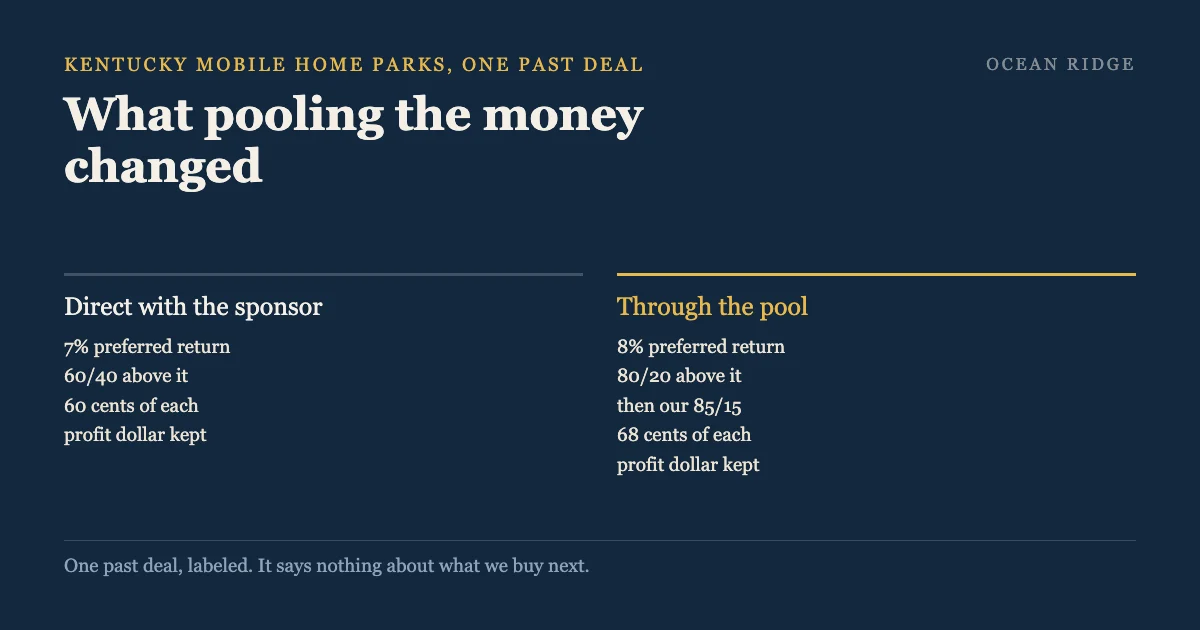
Three things you cannot buy with one check. A deal that is already closed. Terms a pooled commitment negotiates and a single investor does not. And someone who read the offering documents before you did. On our Kentucky parks, pooling moved the split from 60/40 above a 7% preferred to 80/20 above 8%. Direct wins if you can write seven figures and read deals full time.
For educational purposes only. Nothing on this page is investment, legal or tax advice, and nothing here is an offer to buy or sell any security. Ocean Ridge Capital Partners, LLC is not a registered investment adviser, broker-dealer, law firm or accounting firm.
The worry underneath is paying twice for the same deal. You can see the sponsor's fees in the offering documents. Ours sit on top of them, and nobody in the room is going to volunteer what that second layer is worth. So the real question is not whether a layer exists. It is what the layer buys that a direct investor cannot buy on their own, and whether that is worth more than it costs.
Four things, in the order they matter.
This is one past deal, labeled as such, and it says nothing about what we buy next.
| Term | Direct with the sponsor | Through the pooled commitment |
|---|---|---|
| Preferred return | 7% | 8% |
| Split above the preferred | 60/40 | 80/20 |
| Our share of what reaches the vehicle | none | 85/15 |
| Profit dollar kept by the investor | 60 cents | 68 cents |
The assets are mobile home park portfolios near Lexington and Frankfort, Kentucky. Investors who went straight to the sponsor were offered 60/40 above a 7% preferred return. We pooled a million dollars of equity and were offered 80/20 above 8%. Our own split takes 15 cents of every profit dollar that reaches the vehicle, which still leaves the investor with 68 cents instead of 60, and a point more preferred return underneath it.
That is the only honest way to price the layer. Not against a brochure, against the terms the same investor could have signed alone.
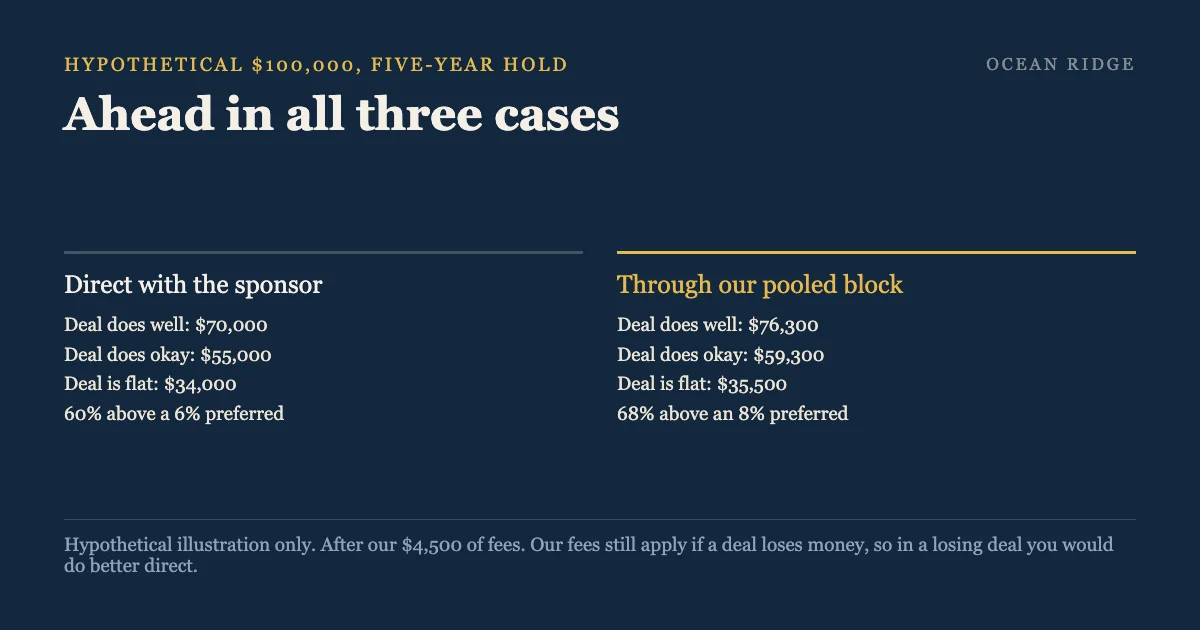
Three cases, and we say so on calls.
There is a case against both, which is that terms are worth nothing on the wrong deal. Our layer earns its keep on the deals we decline, and that is the part of the service no statement will ever show you.
One more test, and it is the fastest one. Ask what the sponsor would sign for your money alone. If the answer is the same terms we were offered, our layer is charging you for nothing. If the sponsor will not take your check at all, the layer is the only way in. Most deals sit between those two, and that is where the arithmetic has to be run one deal at a time.
Our view is that the layer has to pay for itself in terms, not in access. Access is the easy half of the pitch and the weaker half of the argument, because a closed deal you should not own is worth nothing at all. Terms are measurable. Either the preferred return moved, or the split moved, or neither did, and in that last case there is no good reason for anybody to sit in the middle.
So we price it before we commit rather than after. If pooling the money does not change what the sponsor will sign, we are an extra cost on a deal the investor could have reached alone, and we would rather say that out loud than collect on it.
The other half of the work is everything that never gets offered to you. We look at a great many deals a year and commit to two to four. Most of this job is declining, and declining is the part nobody can audit from outside, which is why we publish the filters instead of asking to be trusted.
None of this applies to a sponsor you already know well. If you have invested with them through a full cycle, the relationship is the access. The terms are already yours. It carries less weight inside a retirement account, where a custodian handles the paperwork either way, so the administrative argument mostly goes away. And it does not apply to the first deal of a sponsor's career. There is no record there for anybody to read, us included.
Yes. The sponsor's fees sit in the deal and ours sit on top of them. The question worth asking is whether the terms we negotiate return more than our layer costs, which is answerable deal by deal rather than in general.
You should ask for it. It is in the offering documents for the underlying deal, and a vehicle that will not show you what sits beneath it has told you something useful.
No. It improves them when a sponsor wants one large commitment more than several small ones. On a heavily oversubscribed raise there is nothing left to negotiate with, and we would be buying access only.
Usually nothing happens. You hold a position in the vehicle, the vehicle holds the asset, and neither one is liquid. Size the commitment on that basis rather than on an exit you hope exists.
Ours. You subscribe into the vehicle and the vehicle subscribes into the deal. That is also why your questions come to us rather than to the sponsor.
If you are weighing a deal this year, book an investor strategy call.
Published · Last reviewed
Next step
Not ready to talk? Take the investor quiz and we will send what fits.
Keep reading
How we investBuilding net worth
Not if the vehicle is built right.
How we investBuilding net worth
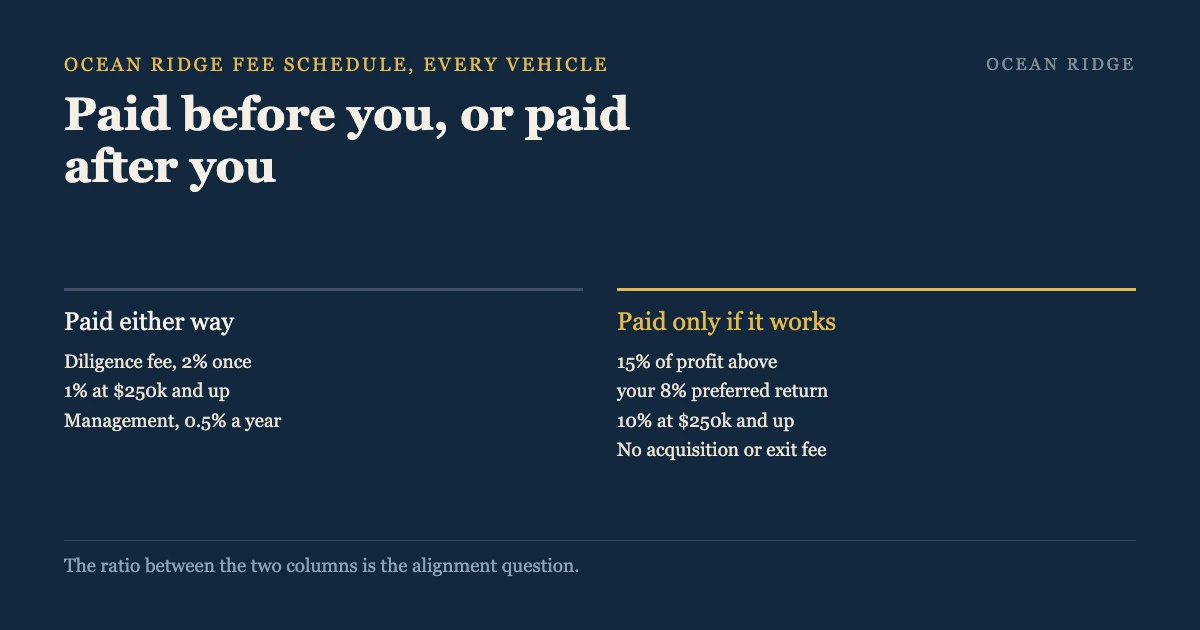
On our most recent equity vehicle, three ways.