
How we investBuilding net worth
What does Ocean Ridge actually do?
We are investors, not a sponsor, not a broker and not an adviser.
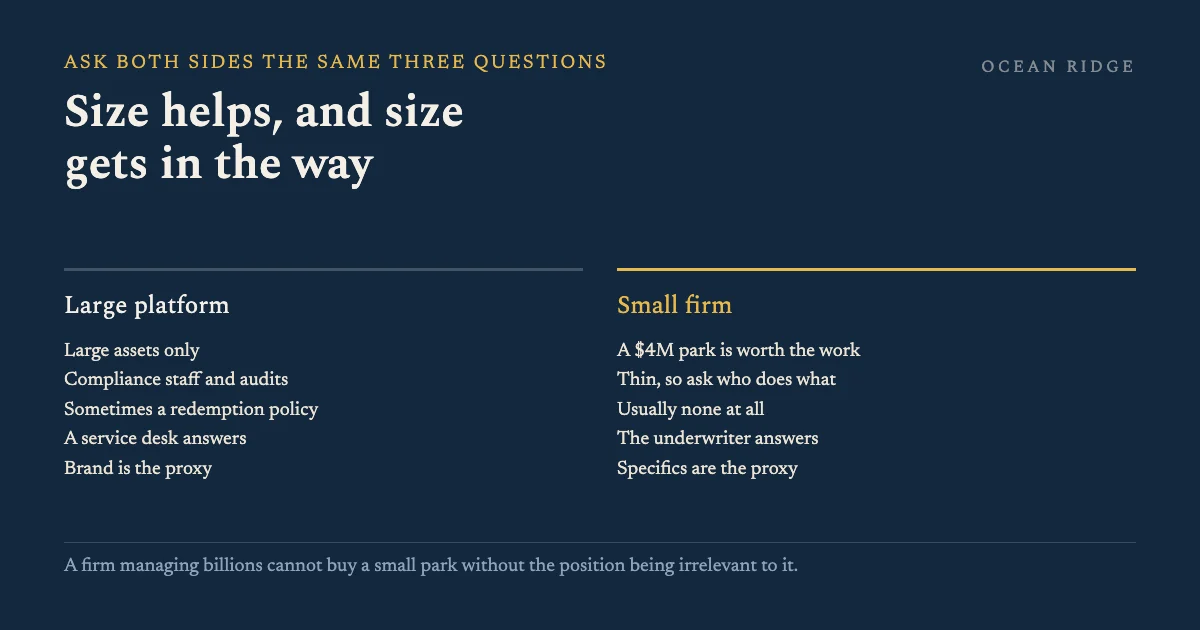
Do not trust either on the strength of the name. A large platform is better at brand, scale and liquidity programs. A small firm is better at deals too small for anyone large to bother with. Ask both the same three questions and see whose answers get specific.
For educational purposes only. Nothing on this page is investment, legal or tax advice, and nothing here is an offer to buy or sell any security. Ocean Ridge Capital Partners, LLC is not a registered investment adviser, broker-dealer, law firm or accounting firm.
The real question is not about size. It is "can I lose my money with you, and would I see it coming". A recognizable name answers that with infrastructure: compliance staff, audited statements, a brand with something to lose. A small firm has to answer it with specifics instead. Both answers can be good. Only one of them can be checked in an afternoon, which is the part worth knowing before you decide.
| Dimension | Large platform | Small firm |
|---|---|---|
| Deal sizes reachable | Large assets only; small ones cannot move the needle | Four million dollar assets are worth the work |
| Infrastructure | Compliance staff, audits, reporting systems | Thin, and you should ask who does what |
| Liquidity features | Sometimes a redemption program | Usually none at all |
| Whose money is in the deal | Often a small share of a very large balance sheet | Often a meaningful share of the principals’ own |
| Who answers the phone | A service desk | The person who underwrote it |
Capacity is the honest version of this. A firm managing billions cannot put money into a small park without the position being irrelevant to its own results. That is not a failing. It is arithmetic, and it is the reason the small end of the market stays uncrowded.
Ask all three of whoever you are speaking to, large or small. The pattern in the answers tells you more than the letterhead.
There is a fourth question, and it is the rudest one. Ask what happened the last time a deal went badly, and what the investors were told at the time. Everybody has one. A firm that cannot name theirs has either not been going long enough to have one, or is editing. Both answers tell you something, and neither of them is in a brochure.
In our favor: we are small enough that a four million dollar park is a real deal rather than a rounding error, our money is in every deal on the same terms as yours, our reviews are verified by a third party rather than collected by us, and the scorecard we use is published so you can argue with it.
Against us, honestly: no redemption program, no brand to fall back on, a small team, and concentration, because an investor in four of our deals holds four exposures rather than a portfolio. If a large platform's liquidity features or breadth matter more to you than negotiated terms on small assets, that is the right call and we will say so. Neither of us is relying on Rule 506 to make the other look bad.
The useful summary is that neither size is the answer by itself. Match the firm to the asset. Then check that the people telling you about it have money in it.
Our view is that trust should be built from checkable things, and that almost everything persuasive about a big name is not checkable by you. The brand is a proxy for diligence somebody else did. It is often a good proxy. It is still a proxy, and it fails in exactly the cases where it matters most.
So we try to compete on the things an investor can verify in an afternoon: third-party reviews we do not control, a public scorecard, the same class of interest as yours, and specific answers about deals we walked away from. None of that is as comfortable as a recognizable logo. All of it is falsifiable, which a logo is not.
We also think the size question has a correct answer per asset. For small, operationally messy assets, small capital wins. For large stabilised assets, it does not, and we do not pretend to compete there.
None of this applies if your constraint is governance rather than returns. An institution, a trust with a corporate trustee or a family office with an investment policy may be required to use managers above a certain size or with audited track records of a certain length, and no amount of specificity from a small firm resolves that. It also does not apply where you need a redemption feature, because a small firm generally cannot offer one at any price.
Third-party reviews the firm does not control, references from investors in a deal that went badly rather than well, the entity filings for its vehicles, and whether the people who answer your questions are the ones who underwrote the deal.
It is better resourced, which is not the same thing. Infrastructure reduces operational and administrative failure. It does not change whether the underlying asset was bought at the right price.
A policy, usually with a cap and a notice period, that can be limited at the manager’s discretion. It is worth something, and it is worth less in the conditions that make you want to use it.
Because large capital is excluded from it by size rather than choice, so fewer buyers compete on price. That advantage lasts only while the asset stays small enough to be ignored.
If you are weighing a deal this year, book an investor strategy call.
Published · Last reviewed
Next step
Not ready to talk? Take the investor quiz and we will send what fits.
Keep reading
How we investBuilding net worth
We are investors, not a sponsor, not a broker and not an adviser.
How we investBuilding net worth
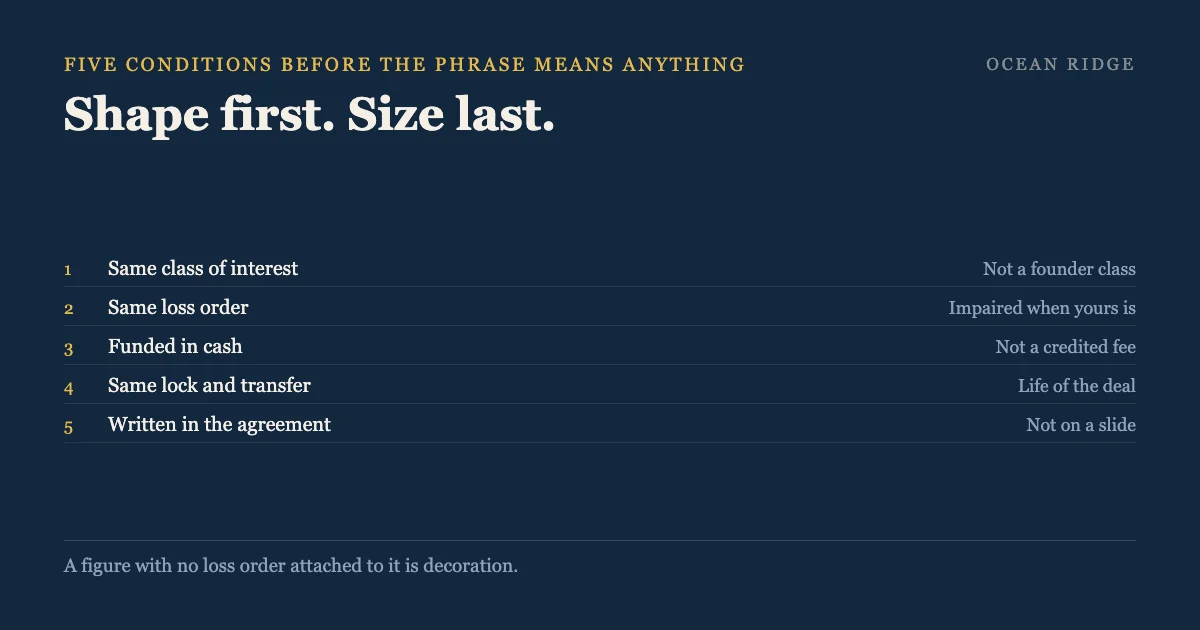
It means our own money sits in the same position as yours, on the same terms, taking the same loss at the same time.