
How we investBuilding net worth
Why invest through a fund of funds instead of going direct to the sponsor?
Three things you cannot buy with one check.
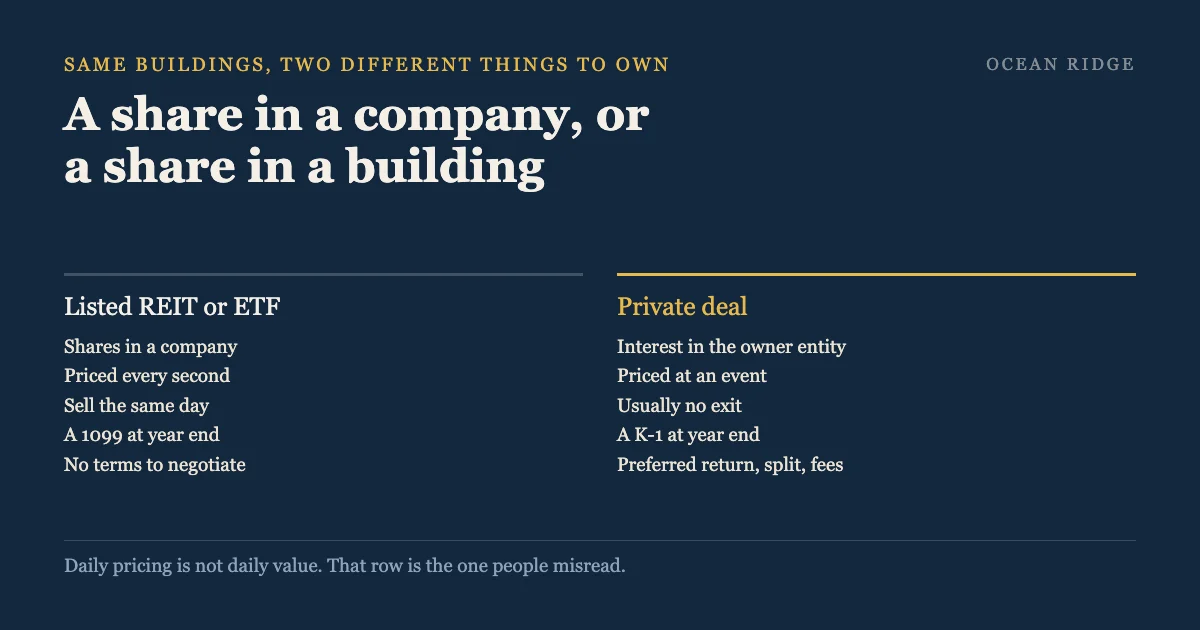
A public fund gives you a tradable share of a company that owns property. A private deal gives you a piece of the property itself, a share of what the partnership reports, and terms somebody negotiated. You give up the ability to sell on a Tuesday. That trade is the whole decision.
For educational purposes only. Nothing on this page is investment, legal or tax advice, and nothing here is an offer to buy or sell any security. Ocean Ridge Capital Partners, LLC is not a registered investment adviser, broker-dealer, law firm or accounting firm.
Underneath this is a fair challenge: why take on illiquidity and paperwork when a listed fund buys the same buildings in one click? The answer is not that private is better. It is that you are buying two different things that happen to share an asset class. One is a share in a company. The other is a share in a building. What they do in your hands is different, and so is what breaks them.
| Question | Listed REIT or ETF | Private deal |
|---|---|---|
| What you hold | Shares in a company, or a basket of them | A membership interest in the entity that owns the asset |
| Pricing | Every second the market is open | At a valuation event, or when it sells |
| Liquidity | Same day | Usually none until exit |
| What arrives at year end | A 1099 reporting dividends | A K-1 reporting the entity’s own items |
| Terms | Whatever the market price is | Negotiated: preferred return, split, fees, reporting |
The pricing row is the one people misread. Daily pricing is not the same as daily value. A listed fund can fall a quarter in a month while its buildings are full and its rents are rising, because you own a share of a company and company shares trade on sentiment.
This part is structural rather than clever. A real estate investment trust has to meet the asset and income tests in 26 U.S.C. 856 and distribute most of its taxable income to keep its treatment under 26 U.S.C. 857. What reaches you is a dividend from a corporation, reported on a 1099.
A private deal is usually a partnership. The entity computes its own items, including cost recovery on the building under 26 U.S.C. 168, and reports your share to you on a K-1. Those are two different pipes. What any particular investor can do with what comes out of either one depends entirely on their own circumstances, and that is a conversation for their accountant rather than for a web page.
What any of that is worth to a particular investor is a question for their own accountant. Some investors may, depending on their situation, find the difference decides which one they buy, and others find it changes nothing at all.
One practical consequence of the pipes. A listed fund is simple in March. A private deal is not, and the K-1 often arrives later than you want it to.
Often, and we would say so.
What you are giving up in exchange is the negotiation. Nobody negotiated your entry price on a listed fund, and no preferred return sits underneath your position.
There is a middle path, and it is the one that gets left out of the comparison. Buy the listed version while you build the cash and the knowledge. Move a slice into private deals once you can afford to lock it up. Nobody has to choose once and for all. What you cannot do is treat a private deal as the liquid part of a portfolio, because it never is.
We do not think of these as competitors. Listed property is a market exposure and a private deal is an asset purchase, and an investor can sensibly hold both. What we object to is the comparison being run on return alone, as though the illiquidity were a detail. It is not a detail. It is the price of admission, and it is the reason the terms are negotiable at all.
The way we test it is to ask what has to be true for the private version to win. Usually it is one of two things: a negotiated structure the public market does not offer, or an asset class too small for large capital to buy. If neither is true for a given deal, an investor is paying illiquidity for nothing, and the listed version is the better answer.
We would rather send somebody to a listed fund than take money that should not be locked up. That decision tends to come back years later as a relationship.
Non-traded vehicles sit between the two and do not behave like either. They are private in valuation and semi-liquid by policy, and that policy can be suspended. Interval funds and semi-liquid alternatives have the same shape. None of this comparison holds for them, and the questions to ask there are about the redemption mechanism rather than about what you own.
No. There is nothing to hold there. Private interests are subscribed for directly or through a custodian, and they do not settle on an exchange.
No. A trust computes its own items and distributes income as a dividend, so what you receive is a dividend rather than a share of the entity’s items.
Listed, by a wide margin, because it is priced constantly. Private marks move slowly, which conceals volatility rather than removing it.
The entity has to close its own books before it can report your share, and when one deal sits inside another the wait compounds. Extensions are normal rather than a warning sign.
Most investors who do private deals keep listed property as well, because the two solve different problems. One is where the money waits. The other is where it gets committed.
If you are weighing a deal this year, book an investor strategy call.
Published · Last reviewed
Next step
Not ready to talk? Take the investor quiz and we will send what fits.
Keep reading
How we investBuilding net worth
Three things you cannot buy with one check.
Real estatePassive income
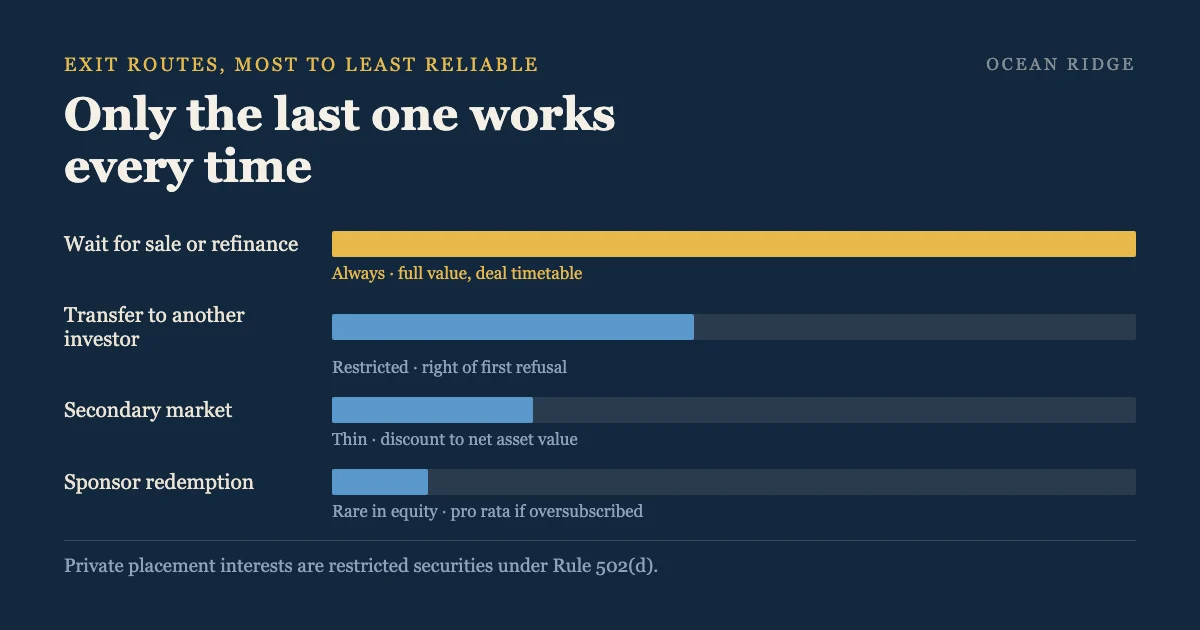
Not in a private real estate deal, which usually runs three to ten years.