
How we investBuilding net worth
What are declination triggers? The seven pass/fail gates for real estate equity deals.
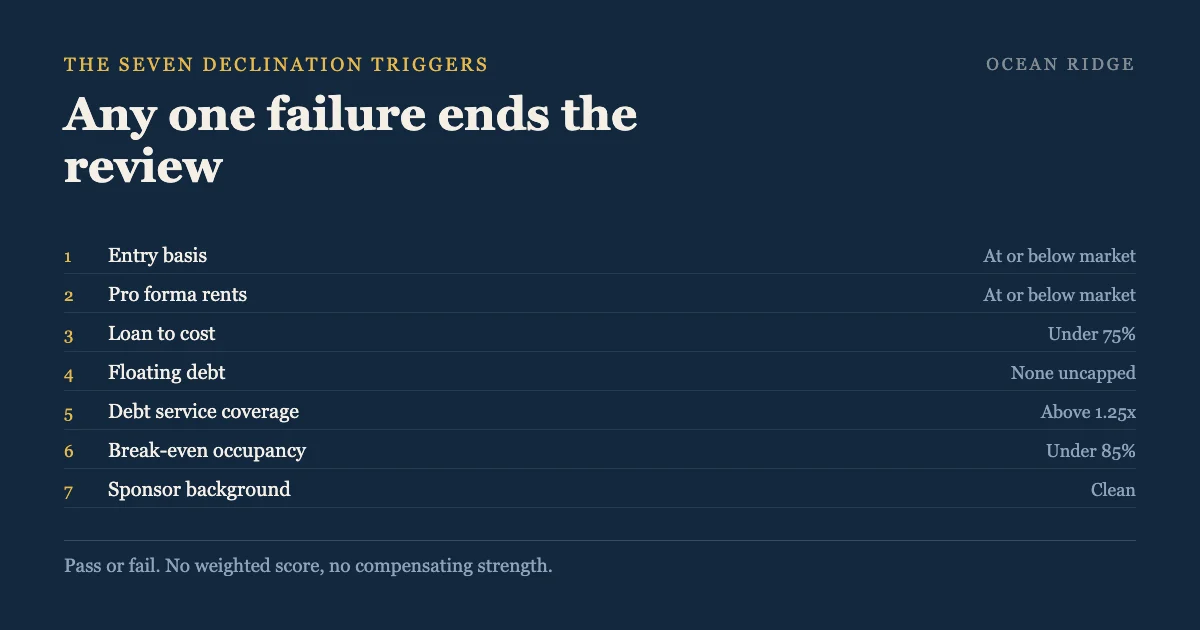
Declination triggers are seven pass/fail tests we run on every real estate equity deal before we spend a day on diligence.
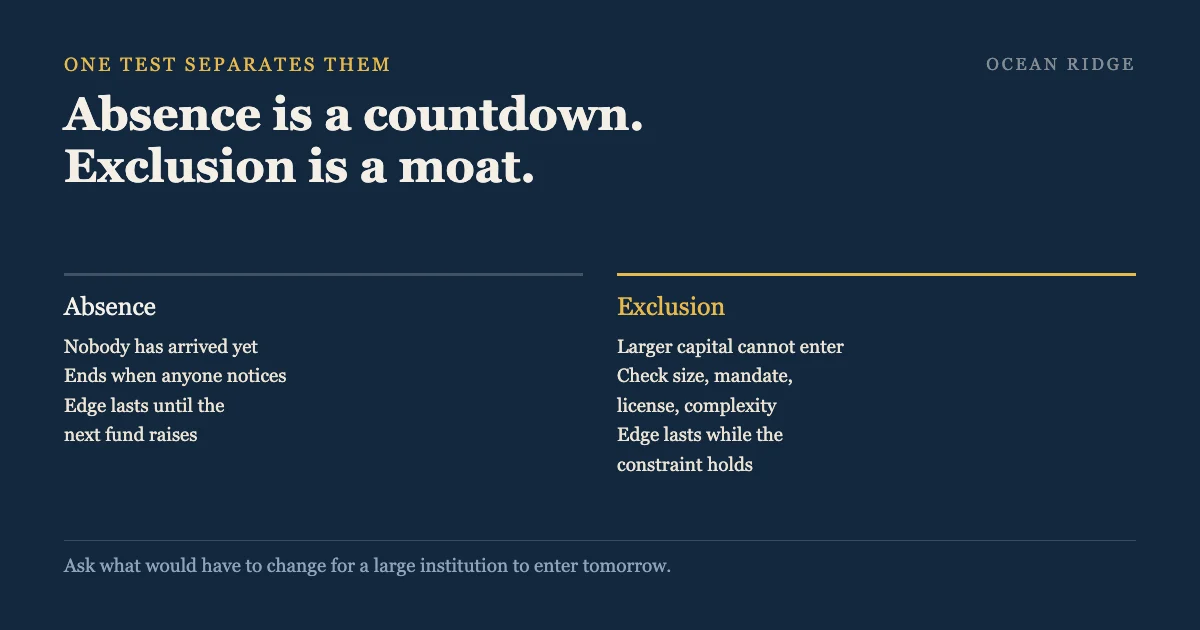
We ask why nobody else is there. If big money simply has not noticed yet, the edge is a countdown. If something structural keeps it out, like deal size, rules or licensing, the edge can last. One question separates the two, and most pitches for “overlooked” niches fail it.
For educational purposes only. Nothing on this page is investment, legal or tax advice, and nothing here is an offer to buy or sell any security. Ocean Ridge Capital Partners, LLC is not a registered investment adviser, broker-dealer, law firm or accounting firm.
You have heard “overlooked” in every pitch for a small asset class. Sometimes it is true and the return is sitting there. More often the niche is small because it is bad, or it is about to stop being small. From outside, all three look the same. You want a way to tell them apart before you pay up for the story.
Absence means big money has not arrived yet. Exclusion means it cannot.
| Absence | Exclusion | |
|---|---|---|
| Why it is uncrowded | Not noticed yet | Something keeps big money out |
| What ends it | Someone noticing | The barrier moving |
| How long your edge lasts | Until the next fund raises | While the barrier holds |
Four things keep big money out. A deal too small to matter to a large fund. Rules that bar the asset. Licensing or operating requirements. And work too hands-on to scale. Each one can be checked.
A $4 million mobile home park is a good example. It is too small for a pension fund to bother with, and it takes hands-on work a big fund cannot do from a spreadsheet. That is two barriers at once.
The four wear down at different speeds. Deal size lasts longest, because it is math, not preference. Rules last until a committee rewrites them. A license can be bought with enough time and money. Operational complexity is the weakest. It disappears the moment someone builds a system for it.
Ask one question. What would have to change for a large institution to come in tomorrow?
The size limit is the edge. A strategy that cannot absorb a billion dollars is one a billion-dollar fund cannot use. There is research behind this. A 2004 study of mutual funds in the American Economic Review by Chen, Hong, Huang and Kubik found performance declines as funds grow, most sharply in funds that hold the least liquid assets.
It fades, and the fading is the exit. Money arrives, prices rise, and returns drift toward the broader market.
That is the plan, not a failure. The discipline is deciding in advance what level of new money tells you the window has closed, then selling to the latecomers. The first sign is usually price, not a new competitor. Watch what similar assets trade for, before anyone writes about the category.
“Overlooked” is the most expensive word in a pitch deck. The question is never whether a niche is small. It is whether something keeps it small, and whether that something is still there.
We will take a strategy with a hard size limit over a scalable one with no barrier. The limit is what the return is paid for. The hard part is that you eventually sell into the crowd you avoided, and selling well is a different skill from finding the niche. The sponsors we trust here name their exit condition before they take the money.
This is a test for categories, not single deals. One well-priced asset in a crowded market can be a fine investment. No barrier rescues a bad operator, so the sponsor check comes first. And if you need liquidity, the barrier that keeps competitors out also keeps buyers out when you want to sell.
No. Small can mean barred by size, which is a barrier, or it can mean nobody wants it. The test is whether you can name what keeps big money out.
Prices move first, usually before anyone writes about it. Watch what comparable assets sell for.
More than most, because removing it takes time and regulation. But licenses tend to get easier to obtain, so ask about the trend.
They should tell you in advance what would make them sell. “When the time is right” is not an exit plan.
The number. A sponsor who knows where the strategy tops out has done the work. One who says capacity is not a concern has not, or plans to keep raising past the point where the edge survives.
If you are weighing a deal this year, book an investor strategy call.
Published · Last reviewed
Next step
Not ready to talk? Take the investor quiz and we will send what fits.
Keep reading
How we investBuilding net worth
Declination triggers are seven pass/fail tests we run on every real estate equity deal before we spend a day on diligence.

How we investBuilding net worth
On our most recent equity vehicle, three ways.