

Private creditPassive income
Is private credit liquid? Lockups, redemption gates, and what a secondary looks like.
Usually more liquid than real estate.
Not in a private real estate deal, which usually runs three to ten years. If you want money back sooner, private credit is often a better fit. Loans commonly pay back in 90 days to three years, and many credit funds let you request money back on a set schedule. Either way, size each investment so you never need it back early.
For educational purposes only. Nothing on this page is investment, legal or tax advice, and nothing here is an offer to buy or sell any security. Ocean Ridge Capital Partners, LLC is not a registered investment adviser, broker-dealer, law firm or accounting firm.
If you own a business, you already know what illiquid feels like. Most of your net worth is probably tied up in one company you cannot sell on a Tuesday. So the real question is how to balance that. Which money can be patient, which money you may want back in a few years, and where each one belongs.
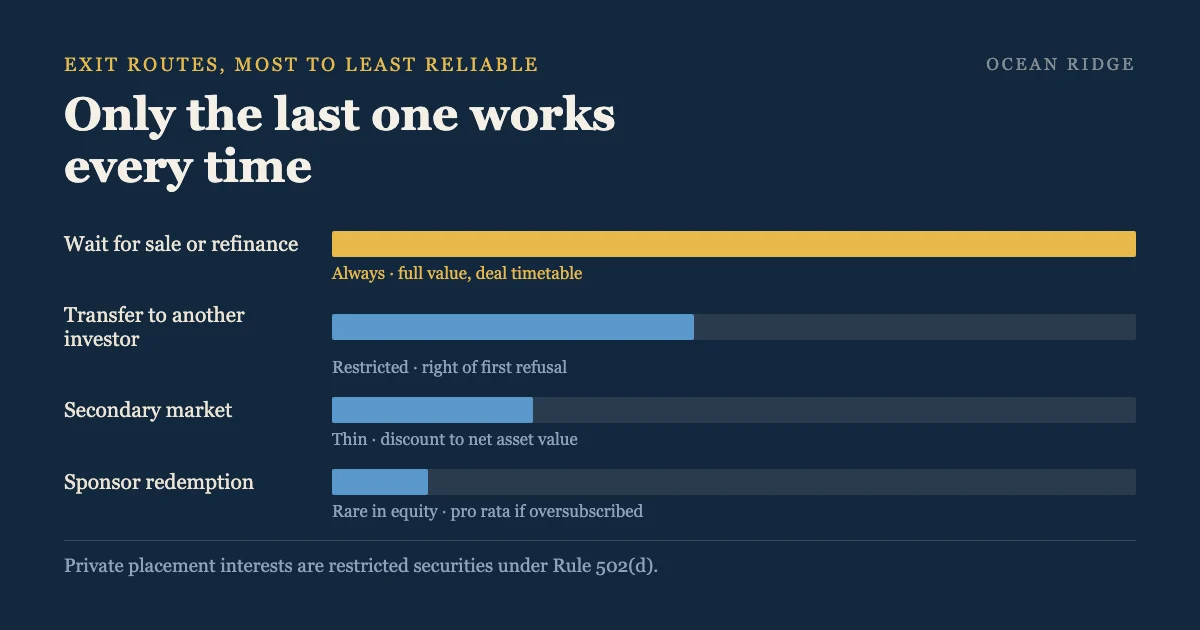
| Route | How often it is there | What you get |
|---|---|---|
| The sale or refinance | Always, on the deal’s timeline | Full value, plus your share of the profit |
| Sell to another investor | Allowed, with limits | Usually a discount. Others may get the first right to buy |
| Secondary market | Thin | A discount to the stake’s value |
| Sponsor buyback | Rare in equity deals | Limited, if offered at all |
The sale is the plan, and it is where the return gets made. The other routes exist but are narrow by design. Interests sold in a private offering are restricted securities under SEC Rule 502(d), so the documents limit transfers.
Because loans end. A real estate deal returns your money when the property sells. A credit fund’s loans pay back on their own schedule, commonly within 90 days to three years, and that steady payback is what funds withdrawals. Many credit funds let you request money back quarterly, after an initial lockup, with limits on how much can leave at once (see #46). For money you may want within a few years, that is often the better home.
Four clauses decide your liquidity. Know them before you invest and there are no surprises later.
Here is a ten-minute test. Write down your three biggest cash needs over the next five years, with a date and a number for each. A tax bill, a house, a business you might buy. Make sure none of them depends on money in a long real estate hold. Money you may need sooner belongs in something shorter.
Illiquidity is part of why the return exists. You are paid to be patient, and a manager who cannot be forced to sell can hold through a bad year instead of selling into it.
The answer for most founders is a mix. Real estate for long-term growth you will not touch. Private credit for income, and for money you may want back in a few years. We say plainly how long each one runs, so you can size it right.
If you need to be able to sell any day, listed investments are the better tool. And if your time horizon is under three years, keep that money out of a long real estate hold, however good the deal looks.
A clause that lets the company, the manager or other investors buy your stake before an outside buyer can, usually at the price you have been offered.
Often, yes. Many agreements let the manager extend one or two times, commonly a year each. Check how many extensions are allowed and who decides.
It goes to your estate and stays in the deal. Your executor inherits the same transfer limits, so tell whoever will handle it.
Commonly 90 days to three years, depending on the strategy. Shorter loans return cash faster, which is part of why credit is often more liquid.
If you are weighing a deal this year, book an investor strategy call.
Published · Last reviewed
Next step
Not ready to talk? Take the investor quiz and we will send what fits.
Keep reading
Private creditPassive income
Usually more liquid than real estate.
How we investBuilding net worth
Not if the vehicle is built right.