
Private creditPassive income
Is private credit a better fit for an IRA than real estate equity?
Often yes, and for one reason.
They do different jobs, so "which" is usually the wrong frame. Credit pays income now and gives up the upside. Equity gives up the income early and builds value over years. A founder with lumpy income often has a use for both. The account question comes second, and it has a clearer answer than the first one.
For educational purposes only. Nothing on this page is investment, legal or tax advice, and nothing here is an offer to buy or sell any security. Ocean Ridge Capital Partners, LLC is not a registered investment adviser, broker-dealer, law firm or accounting firm.
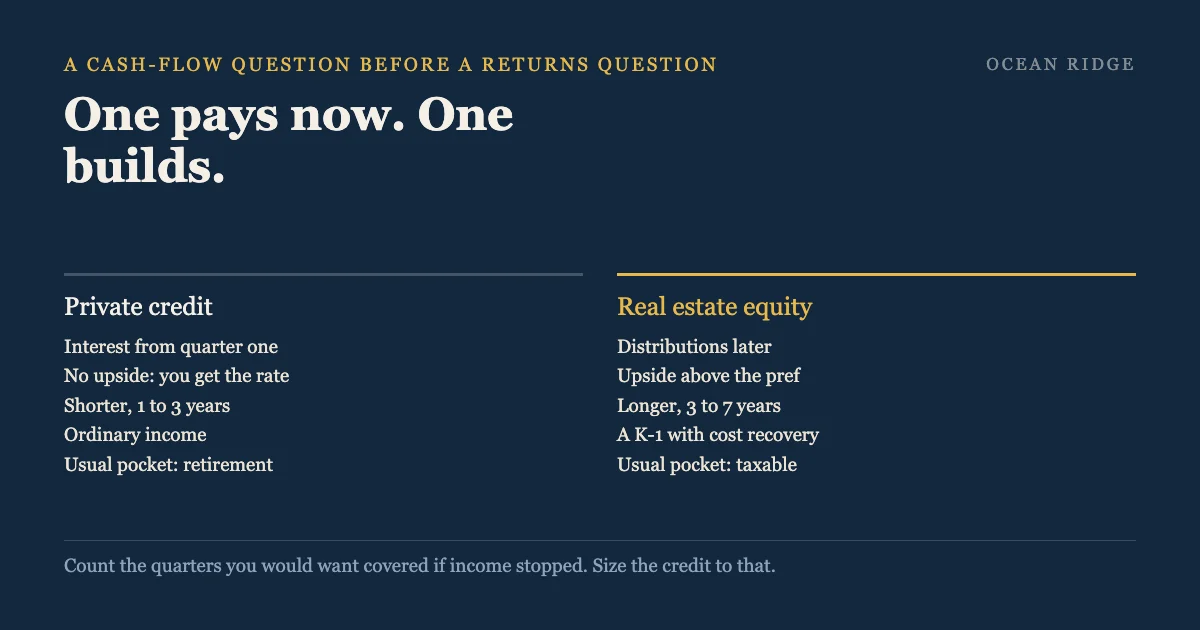
What you want is the menu, with somebody willing to say which thing is for which situation. Fair. The honest version is that this is a cash-flow question before it is a returns question. What does your income look like across a year, how much of it is reliable, and what would you have to sell if it stopped. Those three answers point at a mix far more reliably than any comparison of historical returns does.
| Private credit | Real estate equity | |
|---|---|---|
| What it pays | Interest, usually from the first quarter | Distributions later, then a share of the sale |
| Upside | None. You get the rate | Yours, above the preferred return and the split |
| Typical hold | Shorter, often one to three years | Longer, often three to seven |
| What arrives at year end | Mostly interest income | A K-1 carrying the entity’s own items, including cost recovery under 26 U.S.C. 168 |
| What breaks it | The borrower stops paying | Rates, vacancy, a sale into a bad market |
The row that decides most of it is the second. If you do not need income now, giving up the upside is expensive. If you do need income now, the upside is a promise you cannot spend.
Founders rarely have a salary shaped like an employee’s. Income arrives in large irregular pieces, with long flat stretches between them, and the flat stretches are when people sell things they should have kept.
Credit smooths that. It turns a lump into a quarterly number, which lowers the chance of being a forced seller of the equity position at the worst moment. The equity is what actually builds the balance sheet over a decade. Neither one does the other’s job, and holding only the second is how good positions get liquidated early.
So the mix question is really: how many quarters of expenses do you want covered without selling anything. Answer that, size the credit to it, and the rest can go to work for longer.
There is a second reason the mix helps, and it is behavioural rather than financial. An investor receiving nothing for three years starts to question a position that is doing exactly what it was supposed to do. Income arriving quarterly keeps the long position legible while it works. That is not a return, and it is often what decides whether somebody holds on long enough to get one.
The sizing question has a simple version. Count the quarters you would want covered if income stopped, put that much to work in the thing that pays now, and let the rest run longer.
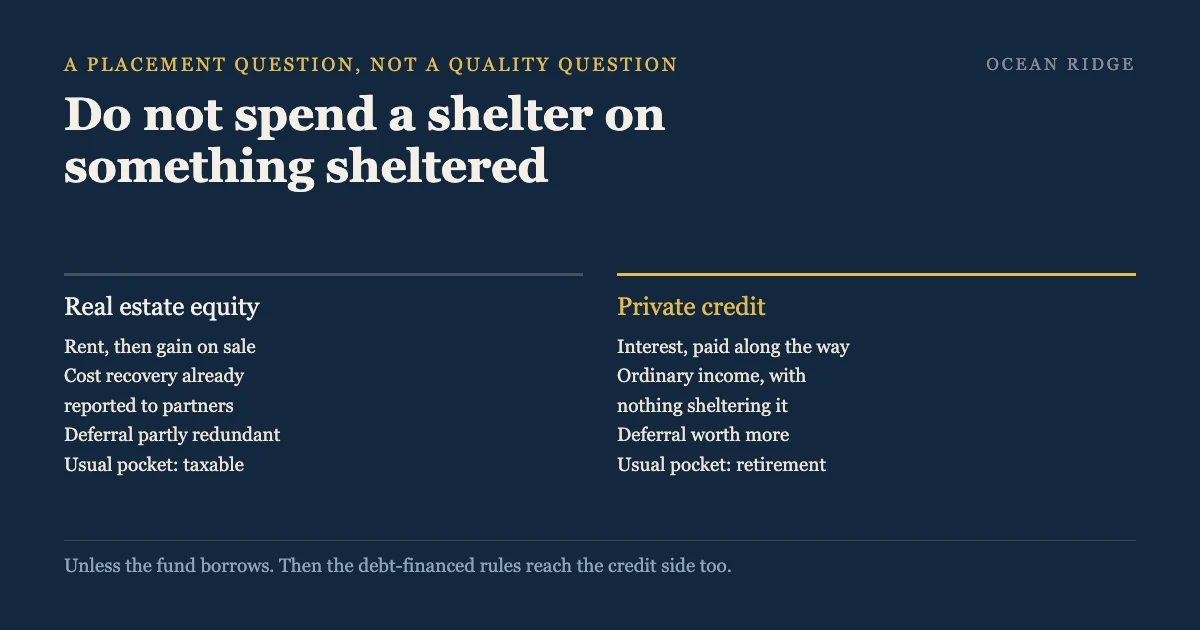
Interest is generally taxed as ordinary income, as IRS Topic 403 sets out, and nothing else is sheltering it. Equity arrives with cost recovery already reported alongside it. So a tax-deferred account does more work holding the first than the second, and the usual ordering is credit in the retirement account and equity in taxable money.
Two things complicate it. A fund that borrows can produce debt-financed income under 26 U.S.C. 514, which reaches a retirement account whichever side it sits on. And a Roth works on a different logic entirely, because the question there is what comes out rather than what is deferred. Some investors may, depending on their situation, find other considerations outweigh the ordering entirely. Your accountant settles it, not a web page, and #12 goes through the mechanics in more detail.
Our view is that this is a cash-flow question dressed as a returns question. Comparing historical returns between the two tells you almost nothing about which belongs in your life, because they fail at different moments and for different reasons. What matters is whether you would be forced to sell something in a bad year.
We also think the order of operations gets reversed constantly. People pick the asset on its numbers and then ask which account to put it in. The account question is cheap to get right and expensive to get wrong, and it costs one conversation held before the wire rather than after.
Where we would push back is on owning only credit. It pays well and it caps you at the rate, and a decade of capped returns is how people end up with income and no balance sheet. Credit is the thing that lets the equity stay invested. It is not the thing that grows.
None of this applies to an investor whose income is already steady and fully covering their life, where the smoothing argument for credit does most of its work elsewhere. It does not apply where the whole position is small enough that splitting it leaves two holdings too small to matter against their own paperwork. And it does not apply to someone who needs the money inside three years, where neither side is the right answer and a listed fund is.
Yes, and plenty of investors do. The ordering argument is about where each does the most work, not about a rule against mixing them.
Over long periods equity has usually paid more, with far more variation. Credit trades that variation away, which is the point of it rather than a shortcoming.
That depends on whether you need income now or later, which is a question about your own cash flow rather than about either asset.
No. We screen it against a separate framework and have committed to nothing, so there are no terms or yields to compare against the equity side.
No, and anyone offering one has not asked about your income. The split follows what you would need if revenue stopped for a year, which is a different number for every founder.
If you are weighing a deal this year, book an investor strategy call.
Published · Last reviewed
Next step
Not ready to talk? Take the investor quiz and we will send what fits.
Keep reading
Private creditPassive income
Often yes, and for one reason.
Private creditPassive income
You are the bank.