

Real estateBuilding net worth
Can I use a self-directed IRA or Solo 401(k) to invest in a real estate syndication?
Yes, through a custodian that allows private placements.
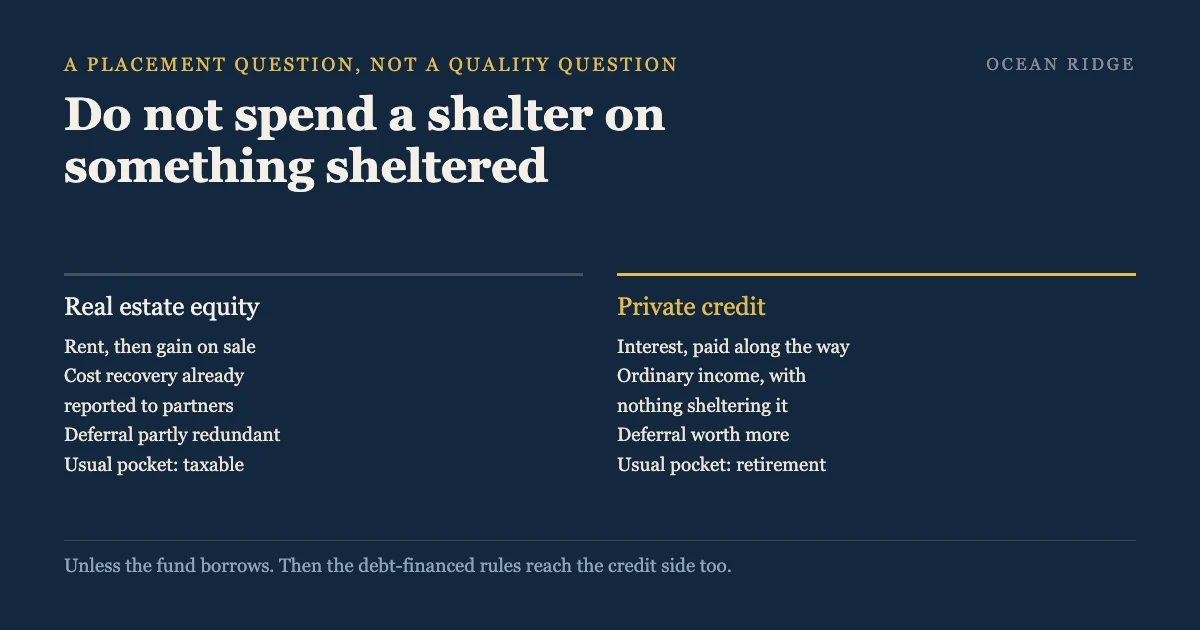
Often yes, and for one reason. Interest is generally taxed as ordinary income, and nothing else is sheltering it. A retirement account is where that does the most work. Equity usually arrives with cost recovery already attached, which is an argument for holding it in taxable money. This is a placement question, not a quality question.
For educational purposes only. Nothing on this page is investment, legal or tax advice, and nothing here is an offer to buy or sell any security. Ocean Ridge Capital Partners, LLC is not a registered investment adviser, broker-dealer, law firm or accounting firm.
What you are really asking is which pocket each thing goes in. Most investors have two: a taxable account and a retirement account. The instinct is to put the best investment in the better account, which is the wrong frame. The accounts treat different kinds of return differently, so the question is not what is best, it is what is wasted where. An asset can be excellent and still be in the wrong pocket.
| Real estate equity | Private credit | |
|---|---|---|
| How the return arrives | Rent, then gain on sale | Interest, paid along the way |
| General tax character | Mixed, with cost recovery under 26 U.S.C. 168 reported to partners | Ordinary income, see IRS Topic 403 |
| Value of a deferred account | Partly redundant | Higher, because there is nothing else sheltering it |
| Leverage inside the account | Common, and triggers the debt-financed rules | Depends entirely on the fund |
| Usual pocket | Taxable money | The retirement account |
The logic is only this. Do not spend a shelter on something already sheltered. A building generates cost recovery. The partnership reports it to its partners, whether the partner is a person or an account. An exempt account has nothing to apply it against. Interest arrives with no shelter of its own, so a deferred account is where it does the most work. Some investors may, depending on their situation, find other considerations outweigh this one entirely.
Credit in a retirement account is not automatically clean. If the fund itself borrows to lend, the same debt-financed income rules in 26 U.S.C. 514 can apply, and a portion of what reaches the account may be treated as unrelated business taxable income. A levered credit fund inside an IRA can end up with the same filing obligation as a mortgaged building.
So the question to put to a credit manager is not the yield. It is whether the fund uses leverage, how much, and whether it is structured in a way that passes debt-financed income through to holders. Managers who deal with retirement money regularly can answer that in one sentence. The ones who cannot are telling you how much retirement money they handle.
The ordering above survives this. It just stops being automatic, and the diligence question changes from the asset to the structure holding it.
There is a second structural question, and it is easy to ask. Does the fund lend through a corporate blocker? A blocker can stop debt-financed income reaching holders, at the cost of tax paid at the blocker level. Neither answer is wrong. What matters is that the manager knows which one they run, and can say so without going to check. Ask before the subscription, because the structure is fixed by then.
It is not a view on an Ocean Ridge credit product, because there is not one. We study private credit, we screen it against a separate framework from the real estate gates, and we have committed to nothing. There are no terms, no yields and no vehicle to discuss, and anyone quoting you numbers for one is quoting something that does not exist.
It is also not a recommendation about your accounts. The placement logic is general and your situation is not. The order of operations here is to talk to your accountant, decide the pocket, and only then look at deals.
One more thing it is not. It is not a reason to rush an account change. The placement decision keeps, and a deal that only works because of which pocket holds it was never much of a deal.
Our view is that placement is the cheapest edge a private investor has, and the most neglected. Nobody can change how an asset performs. Everybody can change which account holds it. The decision costs one conversation, held before the wire goes out rather than after.
It cuts the other way more often than people expect. An investor whose retirement money is the only money they have should not be talked out of an equity deal on placement grounds alone. A good deal in a slightly wrong pocket beats a mediocre deal in the right one. So pick the deal on its merits, then place it as well as the accounts allow.
What we will not do is build a case for credit on tax grounds while there is nothing to invest in. This is how we think about the question, written down before we have a product. Hold the reasoning against whatever we eventually bring you.
None of this holds for a Roth account. There the point is what comes out, not what is deferred, so the sheltering logic is different. It does not hold where an equity deal generates little cost recovery either, as with raw land or a ground lease. Nothing is being wasted there. And it does not hold for an investor whose own rates are low enough that ordinary and preferential rates sit close together. Then the gap this whole argument rests on is small.
Interest is generally ordinary income. Rent from a partnership arrives alongside the entity’s other reported items, including cost recovery, so the net figure that reaches a taxable investor is often smaller than the cash received.
It can, if the fund borrows. Income attributable to acquisition indebtedness may be treated as unrelated business taxable income, and the account files on Form 990-T rather than you personally.
That is generally not possible. A retirement account cannot buy an asset from you, and attempting it is a prohibited transaction rather than a transfer.
No. We screen private credit and have committed to nothing. There are no terms or yields to publish, and this article exists to explain the placement question rather than to sell anything.
If you are weighing a deal this year, book an investor strategy call.
Published · Last reviewed
Next step
Not ready to talk? Take the investor quiz and we will send what fits.
Keep reading
Real estateBuilding net worth
Yes, through a custodian that allows private placements.

Private creditPassive income
Usually more liquid than real estate.