
Private creditPassive income
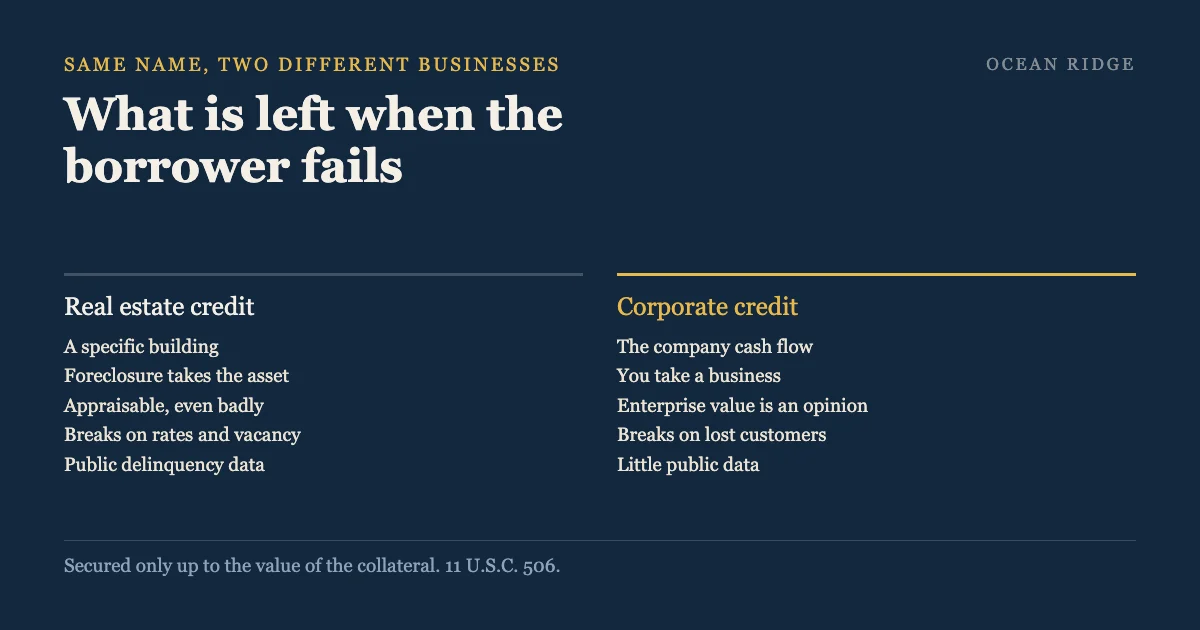
What is private credit, and how is real estate credit different from corporate private credit?
You are the bank.
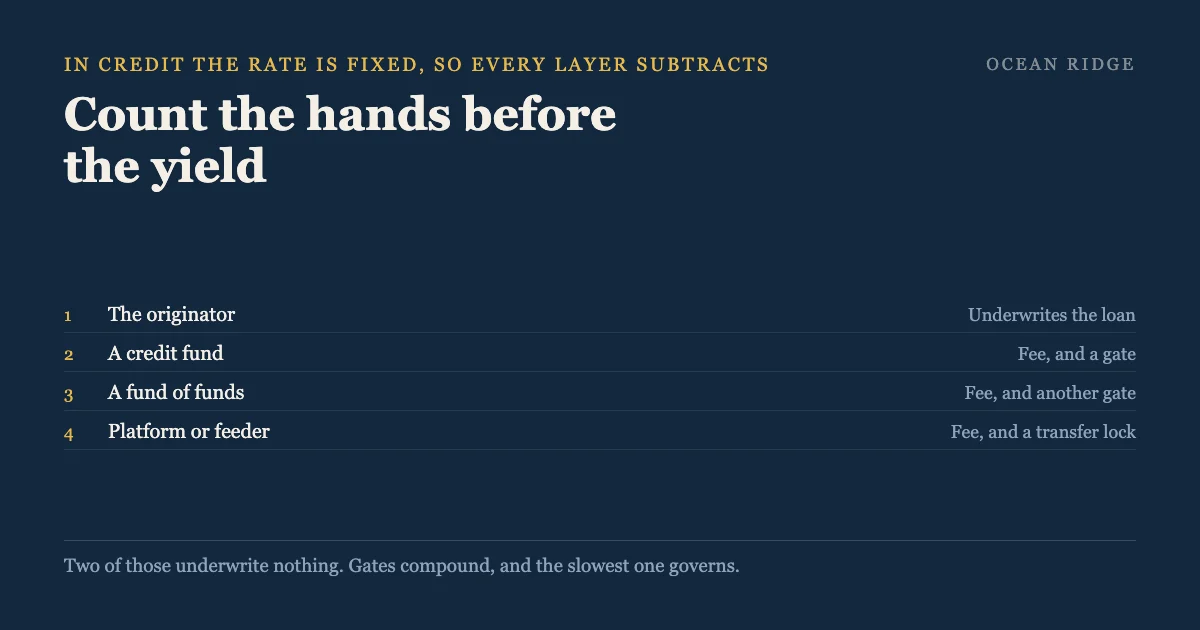
Because in private credit the yield is fixed, so every layer is pure subtraction. Each one takes a point or two and adds a party who can gate your money. We will hold one layer between an investor and the loan: the originator who underwrote it, the collateral behind it, and us.
For educational purposes only. Nothing on this page is investment, legal or tax advice, and nothing here is an offer to buy or sell any security. Ocean Ridge Capital Partners, LLC is not a registered investment adviser, broker-dealer, law firm or accounting firm.
What you are really asking is how many hands are in your yield before it reaches you. It is the right question for credit and a different question from the one you would ask about equity. Equity has upside that a good manager can enlarge. Credit has a fixed rate that every participant reduces. So the arithmetic of layers runs the opposite way, and a structure that makes sense on one side can be indefensible on the other.
| Layer | Typically takes | What it can do to your money |
|---|---|---|
| The originator | Origination and servicing economics | Underwrites the loan. This is the layer doing the actual work |
| A credit fund | A management fee, often a performance share | Sets its own redemption terms and can gate them |
| A fund of funds on top | Another management fee and share | Its own lock and its own gate, on top of the one below |
| A platform or feeder | A placement or platform fee | Another transfer restriction, another set of documents |
Two of those layers underwrite nothing. They select, which has value, and they charge for it out of a return that cannot grow to cover them.
This is the part that does not show up in a fee table. Each layer has its own redemption mechanism, its own notice period and its own cap. Your money has to pass through all of them in order.
A fund with a quarterly window sitting inside another fund with a quarterly window and ninety days notice is not a six-month wait. It is whatever the two together produce, in the conditions that made you ask, and nobody models that in advance. The Fed’s Financial Stability Report for May 2026 records nontraded vehicles limiting redemptions when asset-quality concerns drove requests up. One layer doing that is a problem. Two is a different problem.
Registered funds have had a rule about stacking for years. Rule 12d1-4 sets the conditions under which one registered fund may invest in another, with limits built specifically around duplicated fees and control. Private vehicles are not governed by it. The reasoning behind it still applies.
One layer between the investor and the loan. We go to the originator, we look at the collateral ourselves, and we do not buy a fund that buys funds.
The honest cost of that rule is concentration. A fund of funds spreads across managers, strategies and vintages, and we do not. An investor with us in credit would be exposed to a small number of originators and to our judgment about them, which is a real risk and not a rhetorical one.
The second cost is that we say no a great deal. We have looked at more than fifty credit sponsors and committed to none. Some of those were declined on structure alone, which means we passed on managers who may well do fine. That is the trade the rule makes, and we would rather state it than discover it later. Statements to prospective investors in a pooled vehicle sit under 17 CFR 275.206(4)-8, so a rule like this is one you should expect us to be held to.
The rule has one more consequence worth stating. Going direct means we have to do the underwriting ourselves rather than buying somebody else’s conclusion, which is slower and limits how many we can look at in a year. That is a real constraint on scale, and it is the reason we would rather be small in credit than broad in it.
Our view is that selection is worth paying for once and not twice. A layer that reads the documents, prices the downside and negotiates the terms earns its fee. A second layer doing the same job to the first layer's output is being paid for a decision somebody already made.
In equity we take the opposite position, and the reason is arithmetic rather than principle. There, a negotiated share class can return more than the layer costs, so the layer can pay for itself in terms. In credit the rate is the rate, and nothing a second layer negotiates adds to it. One of those is a case we can make with numbers. The other is not.
We would rather be wrong about a manager than invisible to the loan. If we cannot see the collateral and the underwriting ourselves, we are not lending, we are buying somebody else's opinion at a markup.
This does not hold for an investor who wants breadth more than depth, where a diversified fund of funds is genuinely the better instrument and our rule is the wrong one for them. It does not hold where a feeder exists for a legal or administrative reason rather than a commercial one, such as access for a particular account type at no extra fee. And it says nothing about equity, where a negotiated share class can return more than the layer costs and we argue the other way.
Not always, but it has to beat a fixed rate while charging against it, which is a harder test than in equity. Ask what the second layer does that the first did not.
Often three: the originator, a fund, and the platform or feeder you subscribed through. Each set of documents names its own fees, so the count is readable if you look.
Nothing, and that is the real trade here. Fewer layers means more concentration, and we would rather say that plainly than pretend the rule is free.
No. This describes how we would build one and why we have not bought anybody else’s. There are no terms and no vehicle.
Not always. Some exist for administrative or access reasons at no extra cost, and the documents say so. The ones worth questioning are the ones where nobody can explain what the layer does.
If you are weighing a deal this year, book an investor strategy call.
Published · Last reviewed
Next step
Not ready to talk? Take the investor quiz and we will send what fits.
Keep reading
Private creditPassive income
You are the bank.
Private creditPassive income
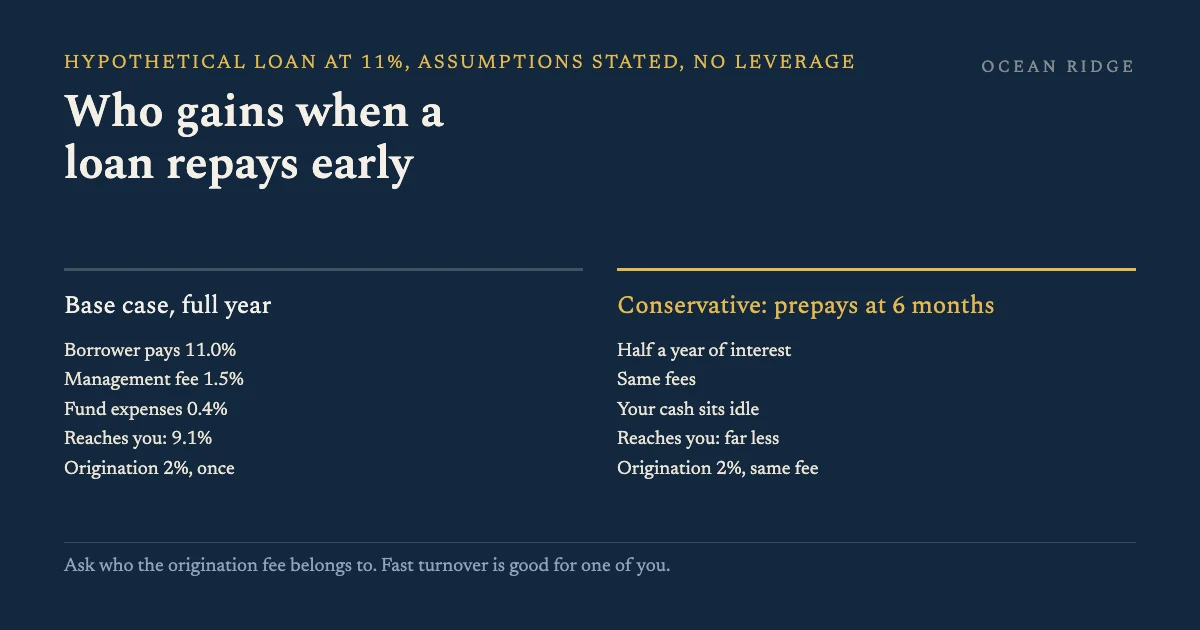
In private credit the spread is the gap between what the borrower pays and what reaches you.