
Private creditPassive income
How does Ocean Ridge evaluate a private credit fund?
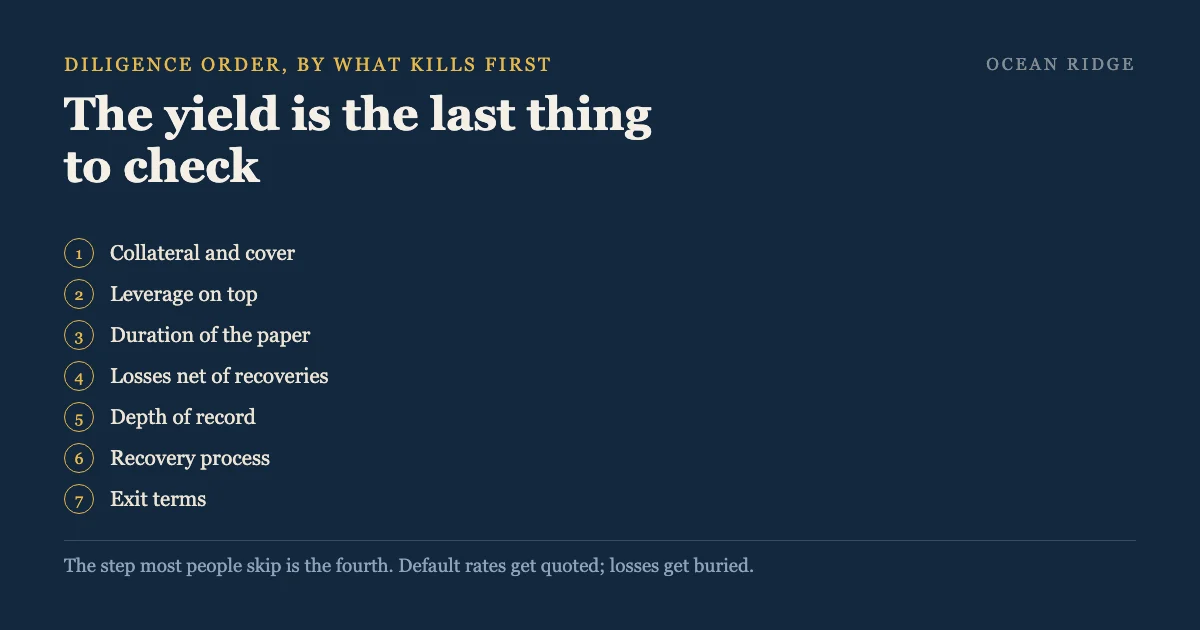
We set the headline yield aside, because they all quote about the same number.
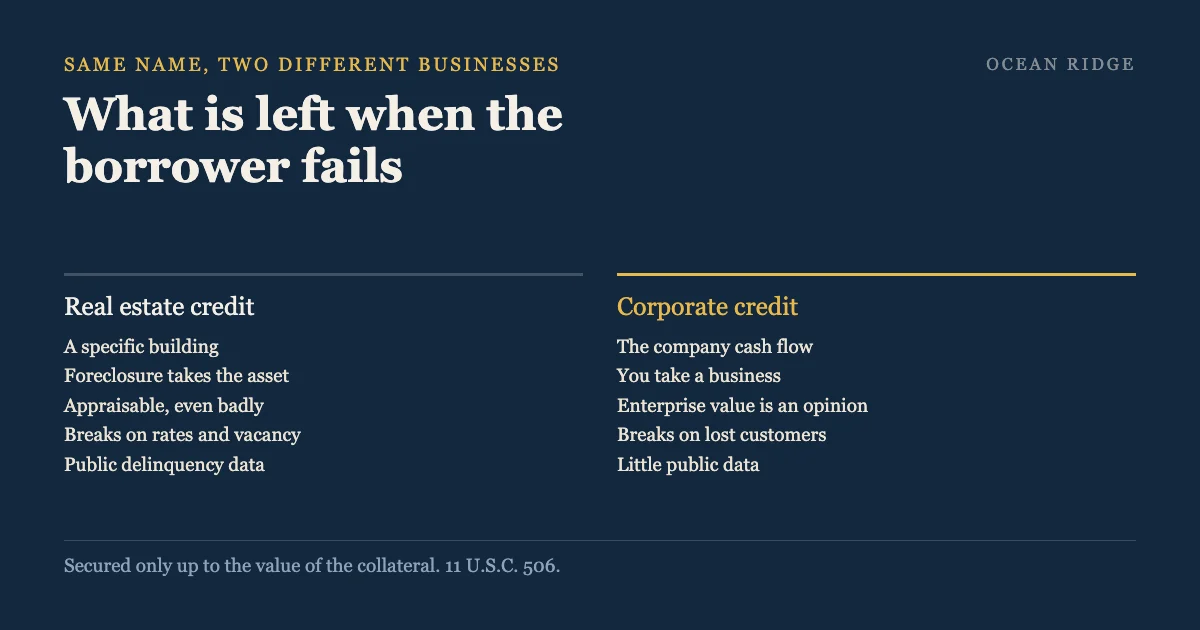
You are the bank. You lend, you collect interest, you get your principal back, and you give up the upside. Real estate credit is a loan against a building somebody can take and sell. Corporate private credit is a loan against a company’s cash flow. When things go wrong those two behave nothing alike.
For educational purposes only. Nothing on this page is investment, legal or tax advice, and nothing here is an offer to buy or sell any security. Ocean Ridge Capital Partners, LLC is not a registered investment adviser, broker-dealer, law firm or accounting firm.
What you are really asking is what somebody means when they use the term at you. It covers two businesses that share a name and very little else. One is secured by a thing that still exists after the borrower fails. The other is secured by a business that may not. Both pay similar headline rates in good years, which is exactly why the distinction only shows up in bad ones.
Three things, and the third is the one people underrate.
That last point changes what diligence means. An equity investor asks how good this could get. A lender asks what happens when it does not work, how long that takes, and what is left.
It also changes who you are really betting on. In equity you are backing an operator to do well. In credit you are backing a borrower to survive, which is a lower bar and a different assessment.
| Real estate credit | Corporate private credit | |
|---|---|---|
| What backs the loan | A specific building | The company’s cash flow, and a lien on its assets |
| What you can take | The building, by foreclosure | A business that may be worth less without its people |
| Governing rules | State mortgage and foreclosure law | Largely UCC Article 9 and the bankruptcy code |
| Valuation in trouble | Appraisable, even at a bad price | Enterprise value, which is an opinion |
| What usually breaks it | Rates, vacancy, a refinancing that does not happen | Lost customers, margin collapse, a sector turning |
The row to sit with is the fourth. In a foreclosure your claim is a secured claim only up to the value of the collateral, under 11 U.S.C. 506, and anything above that is unsecured. On a building, that value is a number an appraiser can defend. On a company, it is a negotiation about what the business is worth without its best year in it.
This is where the two part company for good. A default is a borrower missing payments. A loss is what you do not get back after the work is done. They are different numbers and only one of them matters to you.
Commercial real estate lending has a public record you can read. The Federal Reserve publishes the delinquency rate on commercial real estate loans at all commercial banks as a quarterly series going back decades, so the cycle is visible rather than asserted. Corporate credit has nothing equivalent at that resolution for private lenders, and the Fed’s Financial Stability Report notes the general difficulty of seeing into private credit marks.
So ask both questions of any manager. How many borrowers stopped paying, and how many cents came back. A manager who answers only the first has answered the easier one.
One more distinction worth carrying. In real estate credit the collateral keeps existing while the argument happens. A building does not resign, lose its customers or get worse because the lawyers are busy. A business in a workout usually does, and the longer it takes the less there is to recover. Time works against the corporate lender in a way it does not against the real estate one.
Our view is that credit is a different job from equity and should be judged as one. In equity, being right about the upside is the whole game. In credit, there is no upside to be right about, so everything rests on whether the downside was priced and whether the collateral is real.
That is why we look at real estate credit first. Not because it always pays more, but because the thing behind the loan is a thing. It can be appraised, inspected and sold. A business cannot be inspected in the same way, and the value of one in trouble is an argument rather than a measurement.
We screen credit against a separate framework from the real estate gates, because the questions are not the same ones. We have looked at a great many credit managers and committed to none so far. That is not a view about the asset class. It is where the terms have been.
None of this reaches asset-based lending against receivables or equipment, which sits closer to the real estate side than the corporate one because the collateral is identifiable. It does not reach venture debt, where the real security is the next equity round rather than anything on the balance sheet. And it does not reach a fund that lends across both, where the only honest answer is to ask for the split and judge each half separately.
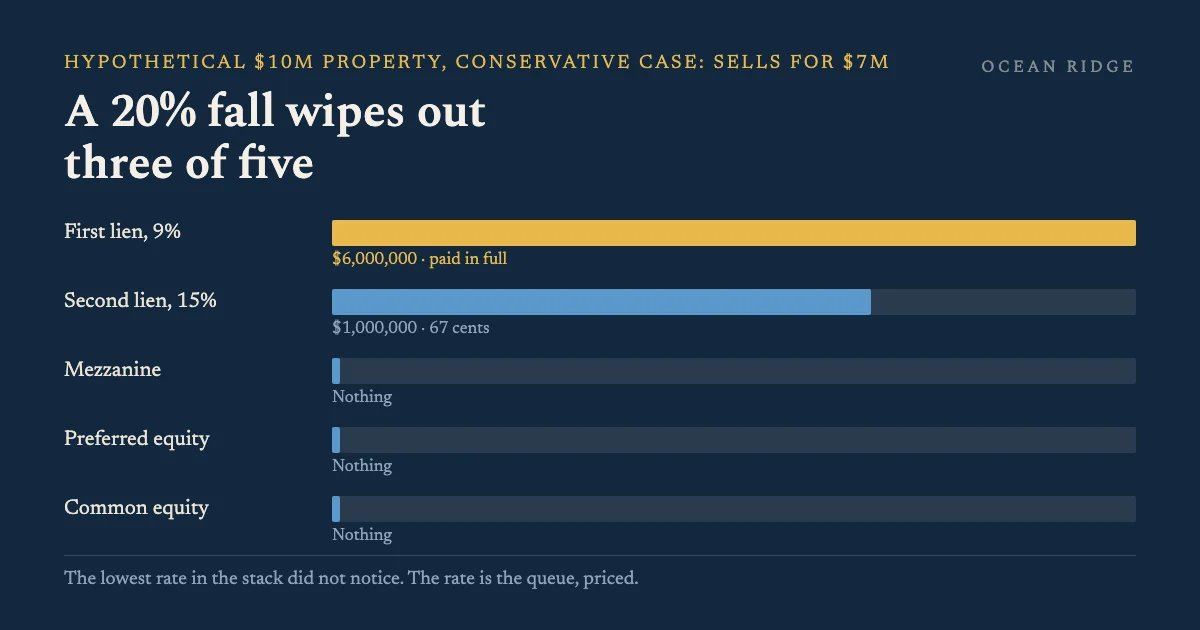
It is earlier in the queue, which is not the same thing. A first lien on a bad building can still lose money. Position reduces loss severity; it does not remove the risk.
Speed, certainty and flexibility, usually. Sometimes because a bank said no, which is the version worth asking about.
That depends on the position, the collateral and the cycle, and anyone quoting a single number without those three is quoting a marketing figure. The useful comparison is the rate against the reference rate at the time.
No. We screen private credit against our own framework and have committed to nothing. There is no vehicle and no terms to discuss.
Plenty do. Ask for the split between the two and judge each half on its own terms, because an average of the two tells you very little about either.
If you are weighing a deal this year, book an investor strategy call.
Published · Last reviewed
Next step
Not ready to talk? Take the investor quiz and we will send what fits.
Keep reading
Private creditPassive income
We set the headline yield aside, because they all quote about the same number.
Private creditPassive income
By the order you get paid when the property sells for less than everyone hoped, and by what you can seize if nobody pays.