
Private creditPassive income
How does Ocean Ridge evaluate a private credit fund?
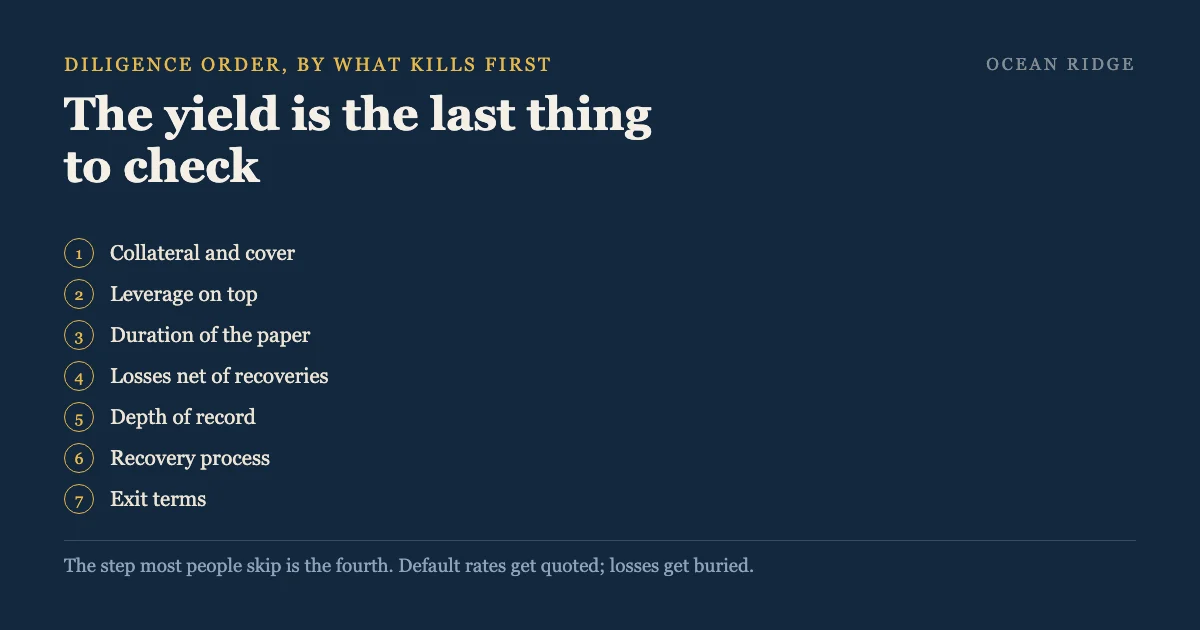
We set the headline yield aside, because they all quote about the same number.
In private credit the spread is the gap between what the borrower pays and what reaches you. Eleven percent means nothing on its own. It means something once you know the reference rate it is priced against, what the manager keeps, and who gets the origination fee. A wide spread on thin collateral is a warning.
For educational purposes only. Nothing on this page is investment, legal or tax advice, and nothing here is an offer to buy or sell any security. Ocean Ridge Capital Partners, LLC is not a registered investment adviser, broker-dealer, law firm or accounting firm.
The question behind this is "is eleven percent good", and it cannot be answered as asked. A rate is only ever good or bad relative to two things: what money costs right now, and what you are lending against. The same eleven percent is generous in one rate environment and alarming in another, and the number alone tells you which only by accident.
Every private loan is priced off a reference rate plus a margin. The reference is usually SOFR, published daily, and the Fed’s H.15 release carries the rest of the benchmark curve. So the first move with any quoted yield is subtraction.
If the reference rate is four and a half and the borrower pays eleven, the margin is six and a half points. That six and a half is the number worth arguing about, because it is the market’s price for the risk in the loan. A quote without its reference rate is a number without units.
This also tells you how to read a track record. A fund that earned eleven when money cost half a percent was taking very different risk from one earning eleven when money costs four and a half, even though the two look identical on a slide.
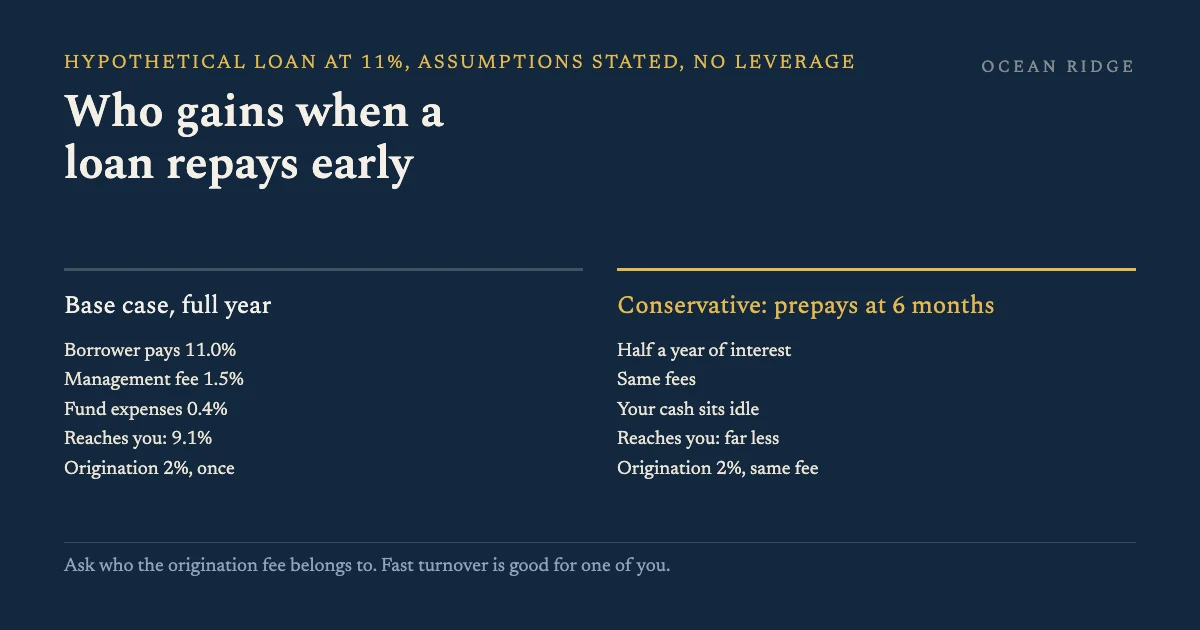
A hypothetical, with its assumptions stated and no claim about any actual fund. Assume a borrower paying 11%, a two percent origination fee charged at closing, a management fee of one and a half percent a year, fund expenses of four tenths of a percent, and no leverage.
| Line | Base case, loan runs a full year | Conservative case, loan prepays at six months |
|---|---|---|
| Borrower pays | 11.0% | 11.0% for half a year |
| Management fee | 1.5% | 1.5% |
| Fund expenses | 0.4% | 0.4% |
| Reaches you | 9.1% | Roughly 4.5% for the half year, then cash |
| Origination fee, 2% | Earned once | Earned once, over half the time |
The conservative column is the one that gets left out. A loan that prepays early pays the manager a full origination fee for half the work, while your capital sits uninvested waiting for the next loan. The manager’s return on that loan went up. Yours went down.
So the question that matters is not the fee schedule. It is who the origination fee belongs to. If it goes to the fund it is yours and prepayment is shared. If it goes to the manager, fast turnover is good for one of you.
A margin far above what comparable lenders charge for comparable collateral is not free money that others missed. It is the price somebody needed to charge to get the loan made. Three things usually explain it, and all three are worth hearing out loud: the borrower was turned down elsewhere, the collateral is harder to value or to sell, or the position is further down the stack than the pitch implies.
Statements made to prospective investors in a pooled vehicle sit under 17 CFR 275.206(4)-8, so these are fair questions to put in writing and fair to expect a straight answer to.
Then ask the simplest version of the question. If this margin is available for this collateral, why is a bank not lending against it at a lower one. Sometimes the answer is good: the loan is too small, too fast or too unusual for a bank process. Sometimes the answer is that a bank looked and said no. Both are answers. Only one of them is an edge.
Our view is that the headline yield is the least informative number in a credit pitch, and it is always the first one offered. We start underneath it: the reference rate, the margin, the fee stack, and where the origination economics sit. By the time those four are on the table, the headline has usually stopped being interesting.
The fee we care most about is the one nobody leads with. Origination economics decide whether a manager is paid to make good loans or paid to make many, and those two businesses look identical for about two years before they diverge sharply.
We also treat a very wide spread as a question rather than an opportunity. Markets are not efficient in private credit, so a real edge can exist. But it has to be explainable in one sentence that survives a follow-up, and most of the time the sentence is about the borrower rather than about the lender.
This reads differently on fixed-rate paper, where there is no reference rate moving underneath you and the spread is set once at origination. It does not apply to a fund that buys loans rather than originating them, where the question is the purchase price against par rather than the margin. And it changes where the manager co-invests heavily in the same loans, because the fee argument weakens when the manager is on both sides of it.
Most floating rate loans price off SOFR now. The important thing is that a reference is named at all, so the margin can be separated from the rate environment.
There is no single right answer, and there is a right disclosure. Ask where it goes, in writing, and read how prepayment is treated alongside it.
Often. A lower margin on first lien paper against appraisable collateral can leave you with more money than a higher one further down the stack.
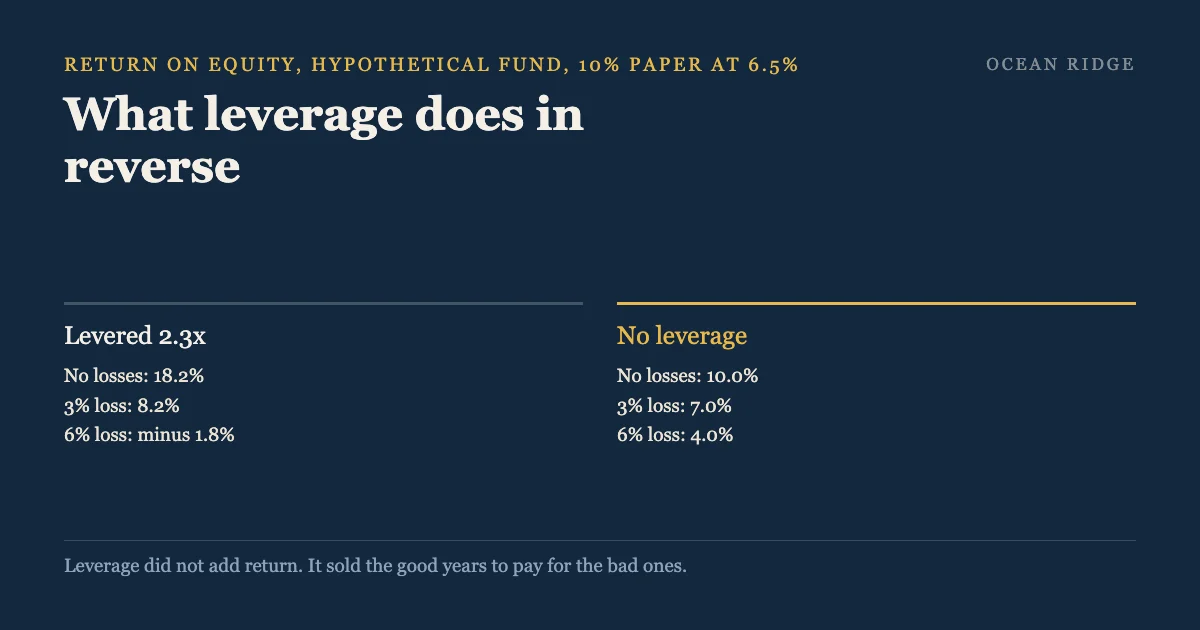
It changes what reaches you, because borrowing costs come out before your return. A levered fund should be able to show the return both ways.
Monthly or quarterly on most floating rate paper, and the loan documents say which. A long reset period is a small bet on the direction of rates that nobody mentions.
If you are weighing a deal this year, book an investor strategy call.
Published · Last reviewed
Next step
Not ready to talk? Take the investor quiz and we will send what fits.
Keep reading
Private creditPassive income
We set the headline yield aside, because they all quote about the same number.
Private creditPassive income
Our line is under one times, meaning the fund borrows less than a dollar for every dollar of investor money.