
Private creditPassive income
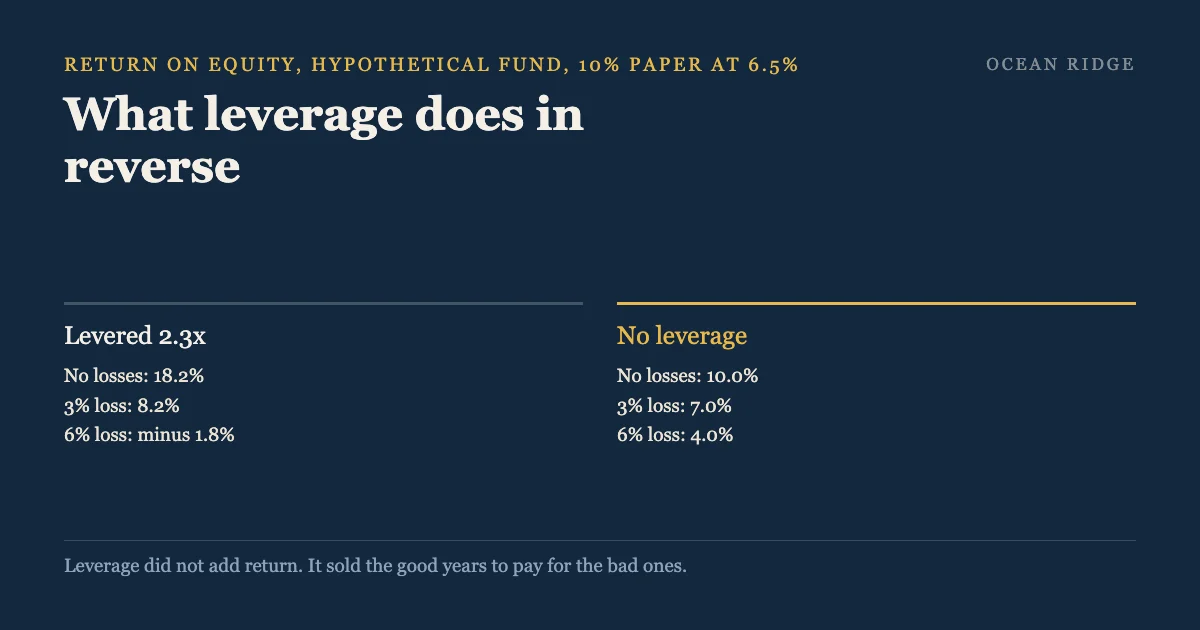
How much leverage is too much in a private credit fund?
Our line is under one times, meaning the fund borrows less than a dollar for every dollar of investor money.
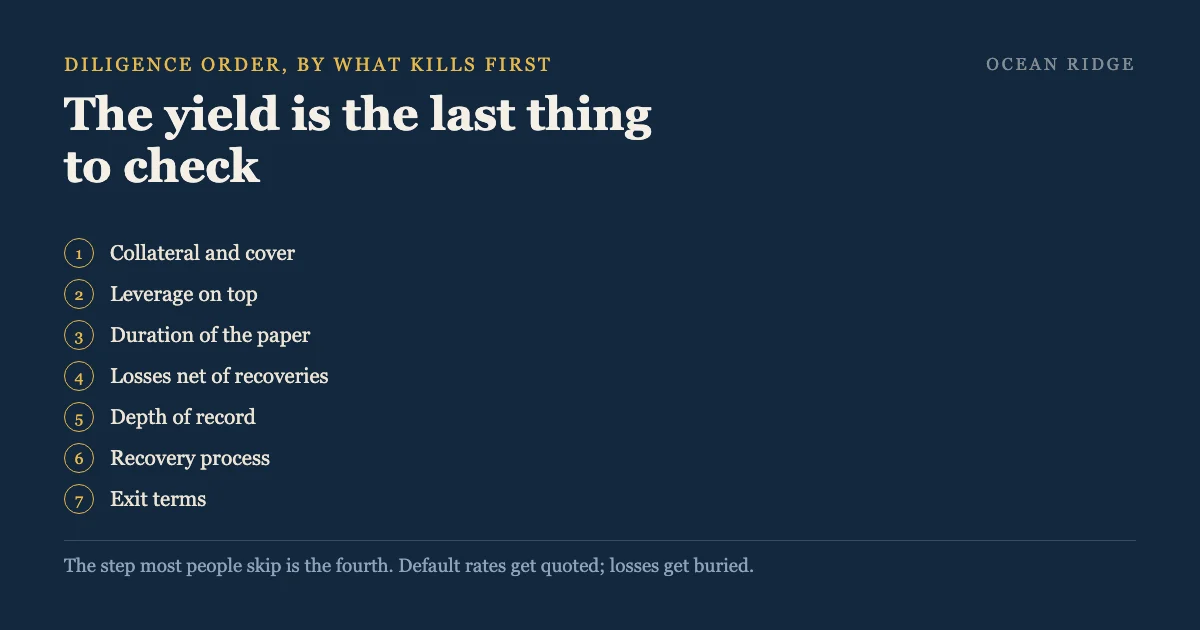
We set the headline yield aside, because they all quote about the same number. We check what actually sinks a credit fund, in order. How far the property can fall before your dollar is at risk. How much the fund borrows. How long the loans run. What it has really lost after recoveries. And how it handled its worst loan.
For educational purposes only. Nothing on this page is investment, legal or tax advice, and nothing here is an offer to buy or sell any security. Ocean Ridge Capital Partners, LLC is not a registered investment adviser, broker-dealer, law firm or accounting firm.
You built a business that pays you. Most of your net worth probably pays you nothing. Private credit is the obvious fix, and then you open six decks that all say about 12%. Nothing on the first page tells them apart. What does is how each fund behaves when borrowers stop paying, and that is rarely on the first page.
We have spent more than a year talking with over 50 private credit managers. Most sounded the same on the first call. This is the order that separated them.
Most people skip number four. Default rates get quoted. Losses after recoveries get buried.
Yes, but it is a price, not a verdict. A first-position loan is paid first and usually pays less. A mezzanine loan sits behind the senior lender and pays more for standing further back in line. Either can be sound. The questions are how much equity sits below your dollar, and whether the extra yield pays you fairly for your place in line. A 9% first lien and a 12% mezzanine loan can both be good investments, or both be bad ones.
When two funds look alike, five things separate them. Whether the loans are insured. How much the borrowers move together, with each other and with the economy. How the income is taxed for you. How good and how frequent the reporting is. And how fast committed money actually gets put to work, since money sitting idle earns nothing.
One more is how the fund itself is financed. Federal Reserve researchers found banks’ committed lending to private credit vehicles grew from about $8 billion in early 2013 to about $95 billion by late 2024. That bank line lets a fund keep lending. It is also a lender that can demand more collateral at the worst moment. Ask who provides it and what happens if it is pulled.
A strong manager gives you the loan-to-value to your last dollar without looking it up. They show losses after recoveries, year by year, next to the default rate. They walk you through their worst loan, what went wrong and what they got back. And they volunteer the unflattering numbers before you ask.
The same Fed research notes that private credit vehicles are largely unregulated and their filings are generally not public. So what a manager will show you matters more here than in most markets, and the good ones show a lot.
Most credit pitches start with the yield and work down. We start with what sinks a fund and work up, because the yield is a promise and the collateral is a fact.
The best signal we have found is whether a manager can walk you through their worst loan without being asked twice. What went wrong, what they did, what they got back and how long it took. A manager who has worked out a bad loan and will show you the file has told you more than a short, clean record can.
This framework is built for loans backed by real property. It fits poorly on loans against a company’s cash flow, where the collateral question looks different. It does not fit venture debt, where the real security is the next funding round. And it is the wrong lens for a fund that earns mainly from origination fees, where the question is whether lending standards hold up when volume pressure rises.
Lower means more cushion. Measure it to the last dollar of your loan, not just the senior lender’s. Above 100% means the collateral does not cover the debt.
A default is an event. A loss is an outcome. A fund can see 10% of its loans default and lose almost nothing if recoveries are strong, or see 2% default and lose a lot if they are not.
Long enough to include a stretch when credit got tight. A few easy years do not prove much, so also look at what the manager did before this fund.
No. It shifts who takes the first loss, which helps, but it adds the insurer as a risk and usually costs yield. Ask what is covered and what is not.
We plan to open an income product in early 2027. It goes through this same screen. Its terms will be in its own offering documents.
If you are weighing a deal this year, book an investor strategy call.
Published · Last reviewed
Next step
Not ready to talk? Take the investor quiz and we will send what fits.
Keep reading
Private creditPassive income
Our line is under one times, meaning the fund borrows less than a dollar for every dollar of investor money.
Private creditPassive income
Usually more liquid than real estate.