
Private creditPassive income
How does Ocean Ridge evaluate a private credit fund?
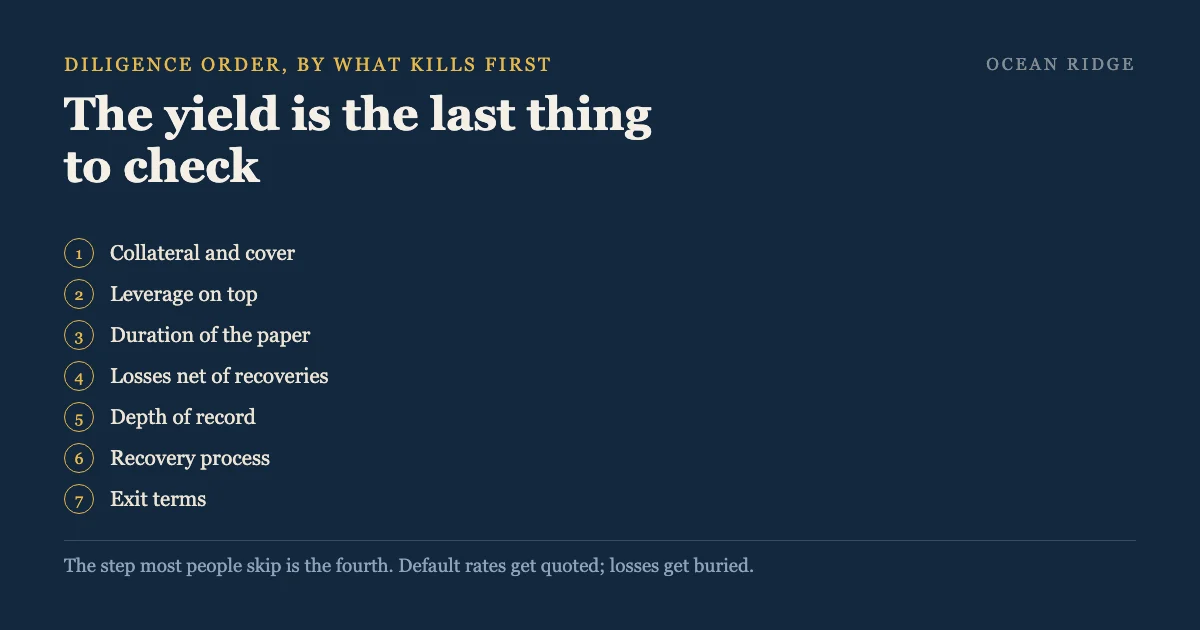
We set the headline yield aside, because they all quote about the same number.
Our line is under one times, meaning the fund borrows less than a dollar for every dollar of investor money. We will look at one to one and a half times only when the loans are backed by investment-grade or government collateral. Above two times we stop looking. At that point the return depends on nothing going wrong.
For educational purposes only. Nothing on this page is investment, legal or tax advice, and nothing here is an offer to buy or sell any security. Ocean Ridge Capital Partners, LLC is not a registered investment adviser, broker-dealer, law firm or accounting firm.
You want to know where the yield is coming from. Two funds can both show 12%. One earns it from the loans. The other borrows at 6.5% to buy 10% loans and keeps the difference. They look the same on the page and behave very differently when borrowers stop paying.
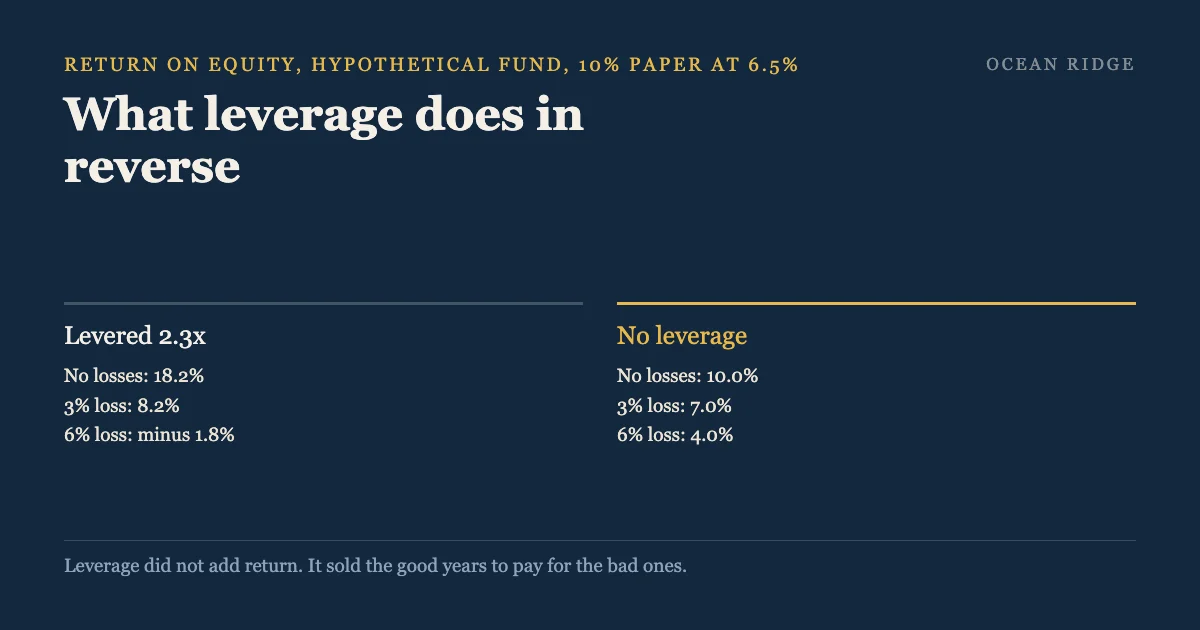
Here is a hypothetical fund, built to show the math, not to describe any fund we have offered. It holds $100 of loans paying 10%, funded with $30 of investor money and $70 borrowed at 6.5%. That is about 2.3 times leverage.
| Hypothetical fund, $100 of loans | No losses | 3% losses | 6% losses |
|---|---|---|---|
| Interest earned on $100 of loans | $10.00 | $10.00 | $10.00 |
| Credit losses | $0.00 | $3.00 | $6.00 |
| Interest paid on $70 borrowed | $4.55 | $4.55 | $4.55 |
| Left for the $30 of investor money | $5.45 | $2.45 | −$0.55 |
| Return to investors, with leverage | 18.2% | 8.2% | −1.8% |
| Return to investors, no leverage | 10.0% | 7.0% | 4.0% |
Leverage is borrowed money divided by investor money. Hypothetical illustration only. Not based on any actual investment and not a projection of future results.
Read the last two rows together. With no losses, borrowing nearly doubles the return, from 10% to 18.2%. At a 3% loss rate it adds about a point. At 6%, the levered fund loses money while the unlevered one still earns 4%. Borrowing did not create return. It made the good years better and the bad years much worse.
The trend is real. Federal Reserve researchers found leverage at business development companies, a common private credit structure, rose from about 40% of assets in 2017 to 53% in 2024, while other nonbank lenders stayed near 42%.
In the fund above, investors’ $30 is the cushion under $70 of debt. Every dollar of loss comes out of that $30 first.
The interest on the borrowing keeps running the whole time. And the bank can demand more collateral or cut the line when values fall, forcing sales at the worst prices. Leverage does not just multiply losses. It takes away your ability to wait.
Under one times, a fund can absorb a bad year. Between one and one and a half, we will look only if the loans are investment-grade or government-backed. Above two, we stop, whatever the collateral story.
We have walked away from a credit fund that looked fine on yield and ran about 2.5 times leverage. The table above is why.
Leverage is not bad by itself. It is a magnifier, and the question is what it is magnifying. On short, well-secured loans, a little is reasonable. On thin collateral, it turns a credit fund into a bet nobody described as one.
We watch the permitted maximum more than today’s number. Leverage is the one risk a manager can raise after you have invested, within documents you already signed, without telling you. What a fund is allowed to do matters more than what it is doing today.
Borrowing against government-backed loans behaves differently, because default risk mostly falls away and interest rate risk takes its place. Very short loans change the picture too, since the book turns over before stress builds. And a fund that borrows briefly to bridge between capital calls is not carrying real leverage. The line worth drawing is between borrowing that buys time and borrowing that buys more loans.
The share of a loan’s value a lender will finance. A 70% advance rate means the fund borrows 70 cents for every dollar of loans and puts up 30 cents of investor money.
In many funds, yes, up to whatever the documents allow. That maximum is the worst case you have agreed to, so find it before you invest.
Yes, and that is the problem. A levered fund and an unlevered one can quote the same yield with very different risk.
Not in the headline. It is usually in the offering documents and audited financials. Ask for the figure and the loan terms together.
If you are weighing a deal this year, book an investor strategy call.
Published · Last reviewed
Next step
Not ready to talk? Take the investor quiz and we will send what fits.
Keep reading
Private creditPassive income
We set the headline yield aside, because they all quote about the same number.
Private creditPassive income
Usually more liquid than real estate.