
How we investBuilding net worth
What is an accredited investor and do I qualify to invest in real estate syndications?
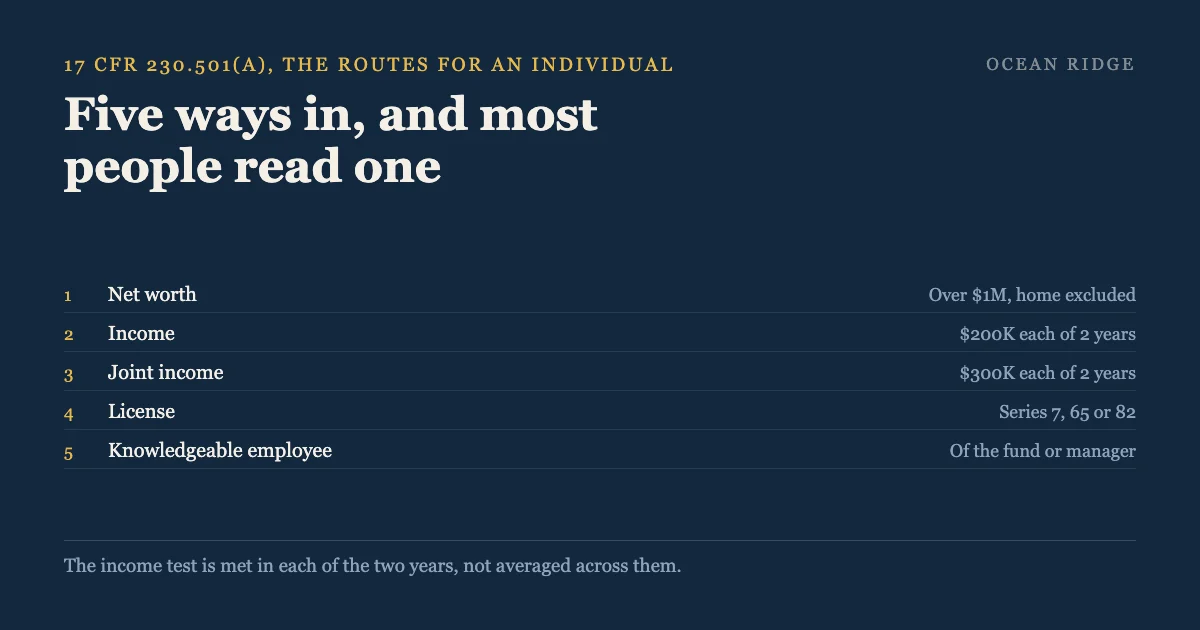
You qualify as an accredited investor on net worth if it is over $1 million, excluding your home.
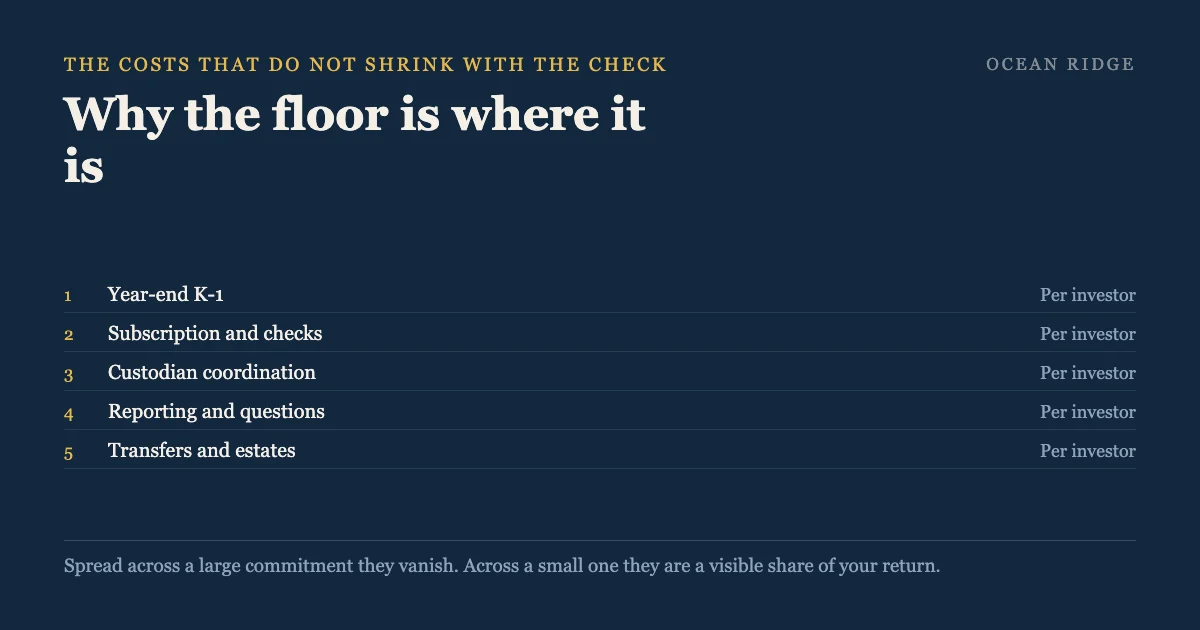
$50,000. Not because smaller investors matter less, but because a set of costs per investor does not shrink when the commitment does. Below that the administration eats a real share of the return, and the sponsor terms we negotiate assume a meaningful commitment behind them. The number is about the structure, not about you.
For educational purposes only. Nothing on this page is investment, legal or tax advice, and nothing here is an offer to buy or sell any security. Ocean Ridge Capital Partners, LLC is not a registered investment adviser, broker-dealer, law firm or accounting firm.
The question underneath is usually "can I start smaller, and are you going to make me feel bad for asking". No. It is a reasonable question and the honest answer is arithmetic rather than preference. Some costs scale with the money and some are the same whoever writes the check. The minimum is where the second kind stops being a rounding error and starts being a drag on your own return.
Five of them, roughly in order of size.
Spread those across a large commitment and they disappear into the decimals. Spread them across a small one and they are a visible share of what you were going to earn. That is the whole argument, and it cuts against small investors rather than against us.
This is the part that is easy to miss. The terms are negotiated against the money arriving as one decision. A sponsor who takes a single large commitment has one investor to report to, one signature to collect and one relationship to manage. The same money arriving in twenty pieces is twenty of each.
There is also a hard limit on investor count in some structures. A sponsor relying on Rule 506(b) may sell to no more than 35 purchasers who are not accredited, and the offering has to be filed with a Form D either way. Even where the count is not capped by rule, it is capped by patience.
So a low minimum is not a free kindness. It is paid for somewhere, usually in weaker terms or in administration charged back to the deal.
Three honest answers, none of which involve bending the number.
What we would rather not do is take a commitment that represents too much of somebody's liquid savings because they qualified on paper. That one comes back as a hard conversation in year three, and we have had it.
There is one more version of this worth naming. Some people can afford the minimum comfortably and still should not write it, because the money is doing a job somewhere else. A deal is not an opportunity if it costs you the ability to wait out a bad quarter in your own business. That is the question we would rather ask on the call than discover in year two.
Our view is that a minimum is a statement about the vehicle, not a ranking of investors. Ours sits where the per-investor costs stop mattering to your result. If we could run the administration for less, the number would be lower, and if the costs rise, it will go up.
We also think the number is the wrong thing to negotiate. Investors occasionally ask us to take half. The answer is usually no, and the reason is not scarcity: it is that the exception has to be absorbed by the other investors in the deal, who did not agree to that.
Where we have made exceptions, it has been for people already in several deals, where the reporting relationship exists and the incremental cost is genuinely small. That is a fact about the cost, not a favor.
None of this applies to a fund with institutional administration, where the per-investor cost is spread across thousands of holders and a minimum of a few thousand dollars works. It does not apply to listed vehicles, which have no minimum at all beyond the price of one share. And it does not apply inside a retirement account in the way people expect: the minimum is the same, but the paperwork takes longer, so the practical floor is a little higher once you count the weeks.
Rarely, and not as a favor. Where it moves it is because an investor is already in several deals and the extra reporting cost is genuinely small. Asking is fine. The usual answer is no.
Sometimes, but it usually defeats the purpose. Two accounts mean two subscriptions and two K-1s, which is the cost the minimum exists to cover.
It tracks the administration cost rather than demand. If the cost of running a vehicle rises, the floor rises with it.
Usually a larger fund with institutional administration, or a platform that charges the investor a fee directly. Both are legitimate. Look for where the cost went rather than assuming it vanished.
That is a question about your own liquidity rather than about the deal. The relevant test is what happens to you if the position returns nothing for five years.
If you are weighing a deal this year, book an investor strategy call.
Published · Last reviewed
Next step
Not ready to talk? Take the investor quiz and we will send what fits.
Keep reading
How we investBuilding net worth
You qualify as an accredited investor on net worth if it is over $1 million, excluding your home.

How we investBuilding net worth
Two to three weeks if you move, and longer if the money comes from a retirement account.