

How we investBuilding net worth
How is accredited status verified in a 506(c) offering, and what do I have to send?
You self-attest to get on the list.
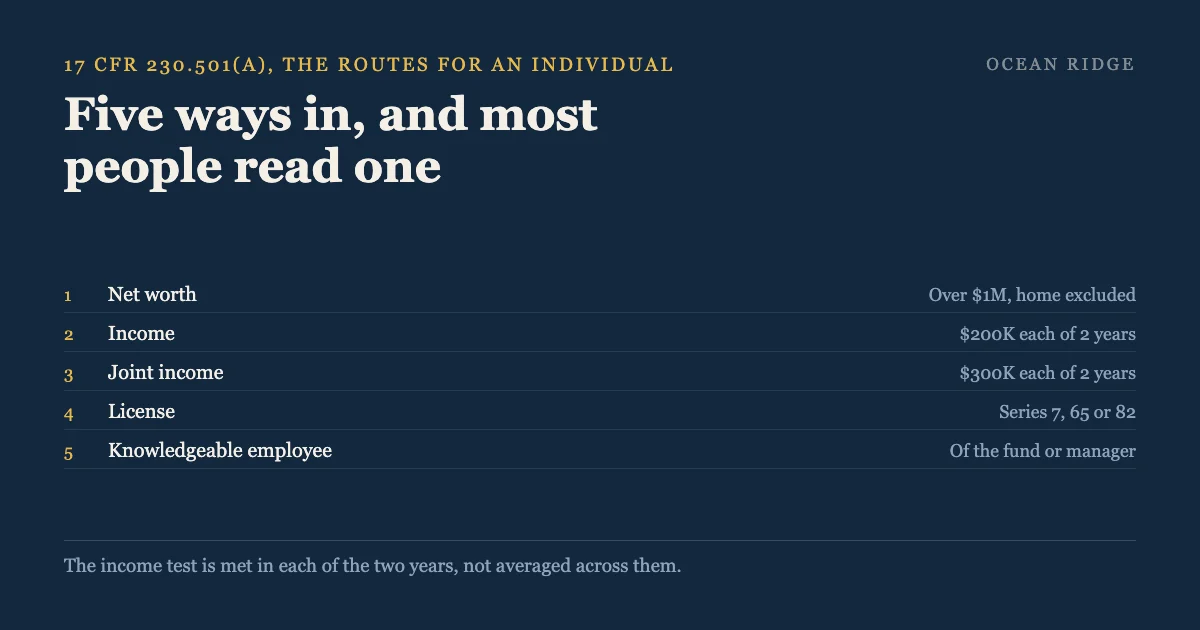
You qualify as an accredited investor on net worth if it is over $1 million, excluding your home. Or on income: at least $200,000 in each of the last two years, or $300,000 with a spouse. There are license routes most articles skip. The test is yours to meet, not ours to grant.
For educational purposes only. Nothing on this page is investment, legal or tax advice, and nothing here is an offer to buy or sell any security. Ocean Ridge Capital Partners, LLC is not a registered investment adviser, broker-dealer, law firm or accounting firm.
The question underneath is whether you are allowed in the room. And whether being allowed in says anything about whether you should be. Those are separate. The rule is a bright line drawn by regulation, not a judgment about your competence. Plenty of people who clear it should still not be buying something illiquid. It decides what may lawfully be offered to you. Nothing more.
The definition lives in 17 CFR 230.501(a). For an individual, these are the common ways in.
| Route | Test |
|---|---|
| Net worth | Over $1 million, alone or with a spouse, excluding the value of your primary residence |
| Income | Over $200,000 in each of the two most recent years, or $300,000 jointly, with a reasonable expectation of the same this year |
| Licenses | A person holding a Series 7, Series 65 or Series 82 in good standing |
| Knowledgeable employee | Certain directors, officers and employees of the fund or its manager |
| Entities | Trusts over $5 million, and entities owning over $5 million in investments, among others |
Two details catch people out. Your home is excluded from the net worth test, but debt secured on it above its value counts against you. And the income test is not an average: it has to be met in each of the two years, not across them.
Status is tested at the time you invest. A change afterwards does not unwind an investment you already made.
This is the part most explainers leave out, and it is the part that affects you. There are two main private-placement lanes under Rule 506.
The ban on general solicitation sits in Rule 502(c). Rule 506(c) is the exemption from it. So the trade is visible. A sponsor who talks about deals in public has taken on a duty to check. You will be asked for documents rather than taken at your word. A sponsor who markets publicly and then asks you to tick a box has a problem.
One practical note. If you are not sure which lane a deal sits in, ask. The answer decides whether you will be asked for documents at all. And a sponsor who cannot say which exemption they are relying on has told you something about how the raise is being run.
It is not a license, a qualification or a signal. Nobody assessed your judgment. The test is a proxy for the ability to carry a loss, and a crude one. A million dollars of net worth tied up in one illiquid asset passes the test and fails the point of it.
It also does not mean a deal suits you. Being allowed to buy something and being right to buy it are different questions. The second one is about your liquidity, your other exposures and your timeline. We have turned away people who qualified comfortably, because they needed the money inside three years.
The rule also moves. The license and knowledgeable-employee routes were added in 2020, and the thresholds themselves have been debated for years. Worth re-checking rather than assuming.
We treat the definition as a floor, not a filter. It tells us what we may lawfully offer you. It tells us nothing about whether you should own something that cannot be sold for five years. The second question is the one that protects people.
So the conversation we want is about liquidity, not eligibility. How much of your money is this. What else of yours is locked up. What happens if this one goes to zero. If those answers are uncomfortable, qualifying is beside the point, and we would rather lose the subscription than take money that needed to stay available.
Where we are strict is the verification itself. A sponsor who markets in public has a duty to check. Treating that as a formality is how one raise gets put at risk for everybody in it, including the investors who did everything right.
None of this applies to offerings that do not use an accredited investor standard. A Regulation A offering is open to non-accredited investors, subject to limits on how much they may put in. Intrastate exemptions work differently again. The entity tests also behave differently from the individual ones. A trust, a retirement account or a single-member company can qualify through its own route, or through the person behind it. Which one applies is a question for the sponsor rather than a given.
No. The primary residence is excluded from the net worth calculation, and so is mortgage debt up to its value. Debt secured on it above that value does count against you.
You need to be accredited at the time you invest. Status is tested at subscription, so a change afterwards does not unwind an investment you already made.
Yes, if you hold a Series 7, Series 65 or Series 82 in good standing. That route was added in 2020 and is still the one most people are surprised by.
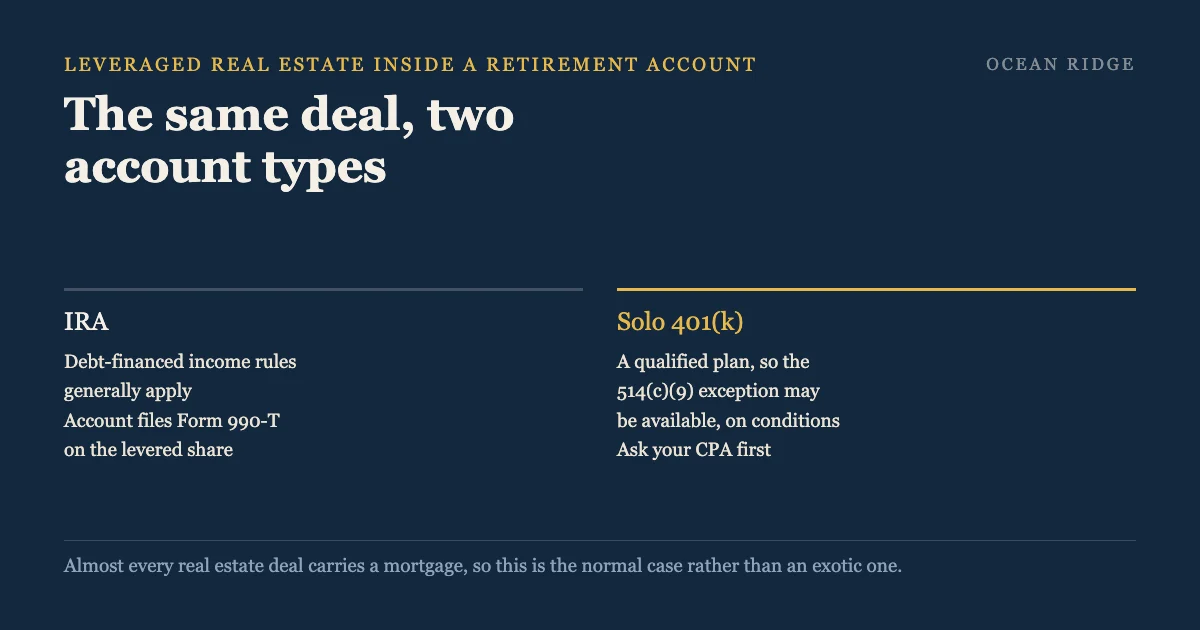
Generally no. Status is assessed on the account and the person behind it, so an account funded by a non-accredited individual does not become eligible by being a retirement account.
No. Qualified purchaser is a much higher bar used for different exemptions, and it is tested on investments owned rather than on income.
If you are weighing a deal this year, book an investor strategy call.
Published · Last reviewed
Next step
Not ready to talk? Take the investor quiz and we will send what fits.
Keep reading
How we investBuilding net worth
You self-attest to get on the list.
Real estateBuilding net worth
Yes, through a custodian that allows private placements.