How we investBuilding net worth
How is accredited status verified in a 506(c) offering, and what do I have to send?
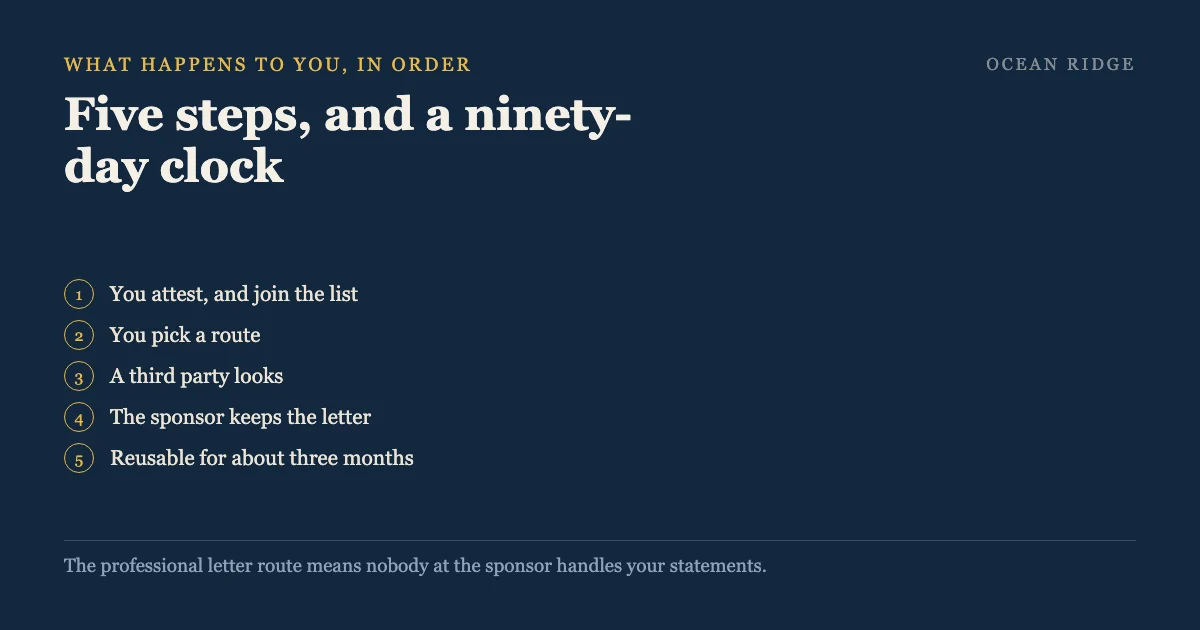
You self-attest to get on the list.
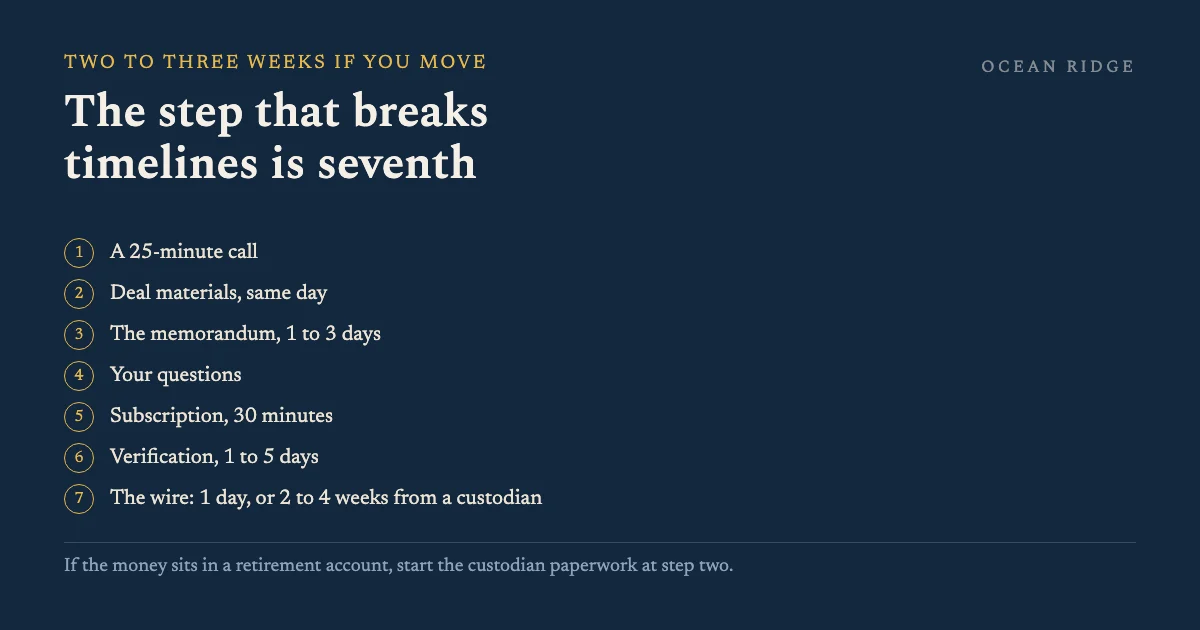
Two to three weeks if you move, and longer if the money comes from a retirement account. A 25-minute call, the deal materials, the private placement memorandum, questions, e-signed subscription documents, accredited verification, then the wire. Most of the elapsed time is waiting on third parties rather than on you.
For educational purposes only. Nothing on this page is investment, legal or tax advice, and nothing here is an offer to buy or sell any security. Ocean Ridge Capital Partners, LLC is not a registered investment adviser, broker-dealer, law firm or accounting firm.
What you are really asking is how much of your life this takes, and whether somewhere in the middle there is a pressure moment. There is not one, and the honest reason is structural rather than virtuous: the closing date is set by the sponsor, so nobody here gains anything by rushing you into a deal you have not read. The parts that take time are a verification letter and a custodian, and neither of those cares how enthusiastic anyone is.
Step seven is the one that breaks timelines. If the money is in a retirement account, start that paperwork at step two rather than step seven.
A private placement memorandum runs to a hundred pages or more and is not written to be enjoyed. These are the parts worth your evening.
| Section | What you are looking for |
|---|---|
| Risk factors | The specific ones, not the boilerplate. A sponsor who knows the asset writes risks nobody could copy from a template |
| Use of proceeds | How much of your money reaches the property, and how much pays fees at closing |
| Distributions and waterfall | The order of payment, the preferred return, the split above it, and whether the preferred compounds |
| Fees and expenses | Everything paid to the sponsor and affiliates, including property management and construction oversight |
| Conflicts of interest | Related-party contracts, and who decides when interests diverge |
| Transfers and withdrawal | Whether you can sell, who has to consent, and what happens on death or divorce |
What a sponsor has to furnish is set out in Rule 502(b), and in practice you receive what the documents promise. So the reading happens before the signature, not after.
Two habits make the reading faster. Read the fees section and the waterfall together, because a fee that looks small in one place can change the order of payment in the other. And read the risk factors last, after you know the structure, because they only mean something once you can picture what they would do to it.
Four things add days, and knowing which is which keeps the process calm.
What does not slow it down is asking questions. The offering is also filed with a Form D after the first sale, which is a public record rather than a gate on you.
Our view is that the subscription process is the first real sample of how a sponsor operates. If the documents are late, the answers are vague and the wire instructions arrive in a hurry, that is information about the next five years and it is cheap to collect.
We also think the reading step is the one nobody should compress. An investor who has read the waterfall and the conflicts section asks better questions for the life of the deal, and an investor who skipped it tends to discover the terms in year two, usually in a bad quarter.
So we would rather you miss a closing than sign something you have not read. There is always another deal, and the relationship is worth more to us than one subscription.
None of this describes a 506(b) offering, where there is no verification step and the timeline is shorter, though the deal cannot be advertised and you have to have known the sponsor first. It does not describe a fund with rolling closes, where there is no single date and the pressure disappears entirely. And it does not describe an institutional process, where legal review on both sides turns two weeks into two months.
Usually not. The documents relate to a specific offering and go out once we know the conversation is relevant, which the call establishes in twenty-five minutes.
You wait for the next deal. Sponsors close when the capital stack is complete, and nobody holds a slot open on a maybe.
Many investors do not and some always do. If the commitment is large relative to your net worth, the cost of a review is small relative to the position.
On the deal’s schedule rather than yours, which is usually a quarter or two after closing. The memorandum says when, and that is the sentence to find.
That works, and it adds a step. The entity has to meet an accredited test of its own and the signatory has to be authorised, so send the formation documents early rather than at signature.
If you are weighing a deal this year, book an investor strategy call.
Published · Last reviewed
Next step
Not ready to talk? Take the investor quiz and we will send what fits.
Keep reading
How we investBuilding net worth
You self-attest to get on the list.