

Real estateBuilding net worth
Can I use a self-directed IRA or Solo 401(k) to invest in a real estate syndication?
Yes, through a custodian that allows private placements.
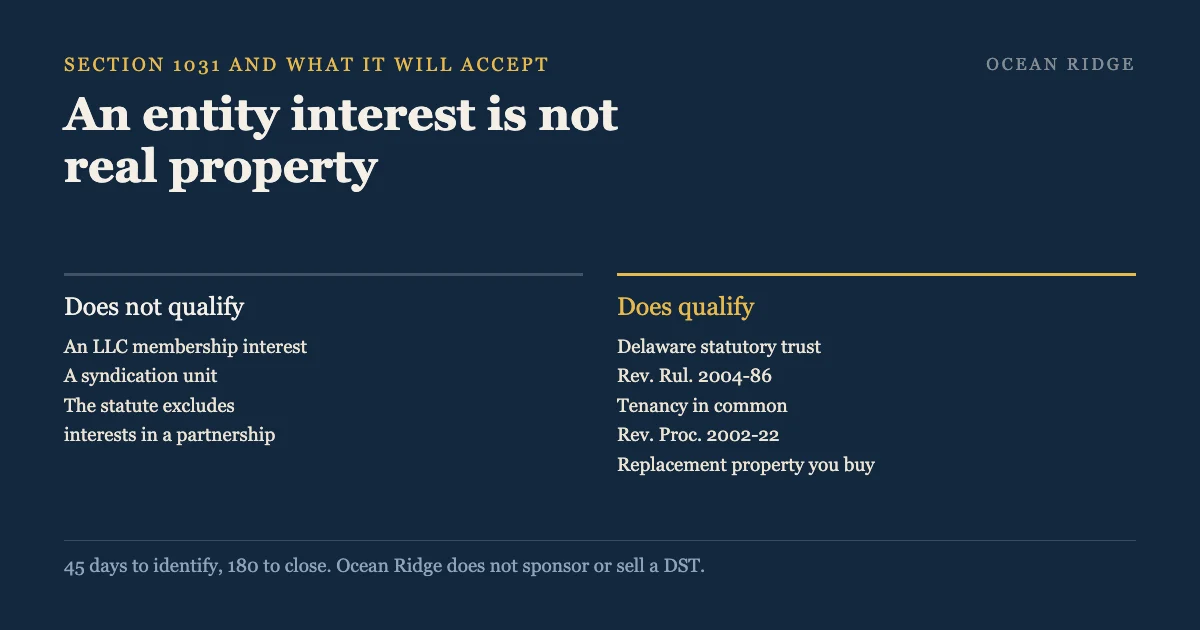
Generally no. A 1031 exchange needs real property, and an interest in an LLC is a partnership interest instead. The statute excludes it by name. Three routes do work: a Delaware statutory trust, a tenancy-in-common interest, or skipping the exchange and letting a new investment report cost recovery instead.
For educational purposes only. Nothing on this page is investment, legal or tax advice, and nothing here is an offer to buy or sell any security. Ocean Ridge Capital Partners, LLC is not a registered investment adviser, broker-dealer, law firm or accounting firm.
The real question is "I am selling something, the clock has started, and I need somewhere for the money". That is a different question from whether the structure qualifies. It means the answer has to arrive with alternatives attached, because a reader forty days into an identification period cannot use a rule on its own. It also means the worst outcome is not a failed exchange. It is a rushed purchase of a bad asset chosen because it qualified.
Section 1031 defers gain on an exchange of real property for like-kind real property. The property has to be held for investment, or for use in a trade or business. Two parts of that do the work.
The first is "real property". A membership interest in the LLC that owns a building is not real property. It is an interest in an entity that happens to own one. The second is the statute's own exclusion list, which names interests in a partnership. Most syndications and single-asset vehicles are taxed as partnerships, so the interest you would receive is the thing the statute excludes.
This is not a drafting problem. Better paperwork does not fix it, because it is what the provision says. Reporting happens on Form 8824, and the question of what you received is answered there.
| Route | What you receive | Authority |
|---|---|---|
| Delaware statutory trust | A beneficial interest treated, in the fact pattern described, as a direct interest in the underlying real property | Rev. Rul. 2004-86 |
| Tenancy in common | An undivided fractional interest in the property itself, held with other owners | Rev. Proc. 2002-22 |
| Buy the replacement yourself | Real property in your own name, with any later contribution to an entity a separate question of timing | Section 1031 directly |
Two conditions sit under the first two rows. Rev. Rul. 2004-86 describes a specific fact pattern. In it, the trustee has almost no power to act. Rev. Proc. 2002-22 sets the conditions the Service will consider before ruling that a fractional interest is not an interest in a business entity. Both reward structures that look like owning property. Both punish structures that look like a managed business.
Ocean Ridge does not sponsor, package or sell a Delaware statutory trust, and nothing here is an offer of one. We are describing the landscape because the question arrives on calls.
An exchange defers. It does not erase. Every deferral carries the basis forward and the gain with it, and a chain of exchanges ends somewhere.
The alternative route is to recognize the gain and look at what a new investment reports in the same period. A partnership that buys real property computes cost recovery and reports each partner's share, and the interaction between that and a gain elsewhere is specific to the taxpayer. Some investors may, depending on their situation, find the two meet in a useful way, and others find they do not meet at all. The classification of the gain matters, the classification of the activity matters, and neither is something a web page can settle.
What is general is the timing. The identification window is 45 days and the exchange period is 180, which is why this question usually arrives late. If you are inside either window, the order of operations is your accountant first and the deal second. Nothing here is tax, legal or investment advice.
Our view is that the exchange should not pick the asset. We have watched investors buy a property they would never otherwise have looked at, because it was identifiable on day 44 and the alternative was a tax bill. The bill was usually the better outcome.
So the question we ask first is what the money would do if there were no exchange at all. If the answer is a deal you actually want, the exchange is a bonus. If the answer is "I would not buy this", the deferral is paying you to make a mistake, and deferral is not worth very much on a bad asset.
The second thing we say is that this is genuinely a question for a CPA who knows your basis, your other activity and your state. We are not that, and a firm that answers it confidently from the outside is telling you something about how it works.
None of this reaches a sale that is not generating much gain, where the whole exercise is machinery around a small number. It does not reach property held primarily for sale, such as a flip or inventory, which is outside the provision to begin with. Personal property and intangibles have been outside it since 2017. And it does not reach an investor whose plan is to hold rather than to sell, where the deferral question never arises.
Some can and most will not. A fractional interest brings co-owner consent rights that complicate financing and sale, which is why Rev. Proc. 2002-22 sets conditions and why many sponsors decline.
No. The economics can look similar, but the trustee has very limited powers by design, because that limitation is what supports the treatment. Less flexibility is the feature.
Forty-five days from the sale to identify replacement property in writing, and one hundred and eighty days to complete the acquisition. Both run from the closing of the sale, and both are strict.
No. We do not sponsor or sell a Delaware statutory trust or any 1031 product, and this article is not an offer of one.
Generally not out of the interest itself, for the same reason you could not exchange into it. What the partnership does with the property is a separate matter and is the partnership’s decision rather than yours.
If you are weighing a deal this year, book an investor strategy call.
Published · Last reviewed
Next step
Not ready to talk? Take the investor quiz and we will send what fits.
Keep reading
Real estateBuilding net worth
Yes, through a custodian that allows private placements.

Real estateTax efficiency
It can, depending on the kind of gain.