
How we investBuilding net worth
What is an accredited investor and do I qualify to invest in real estate syndications?
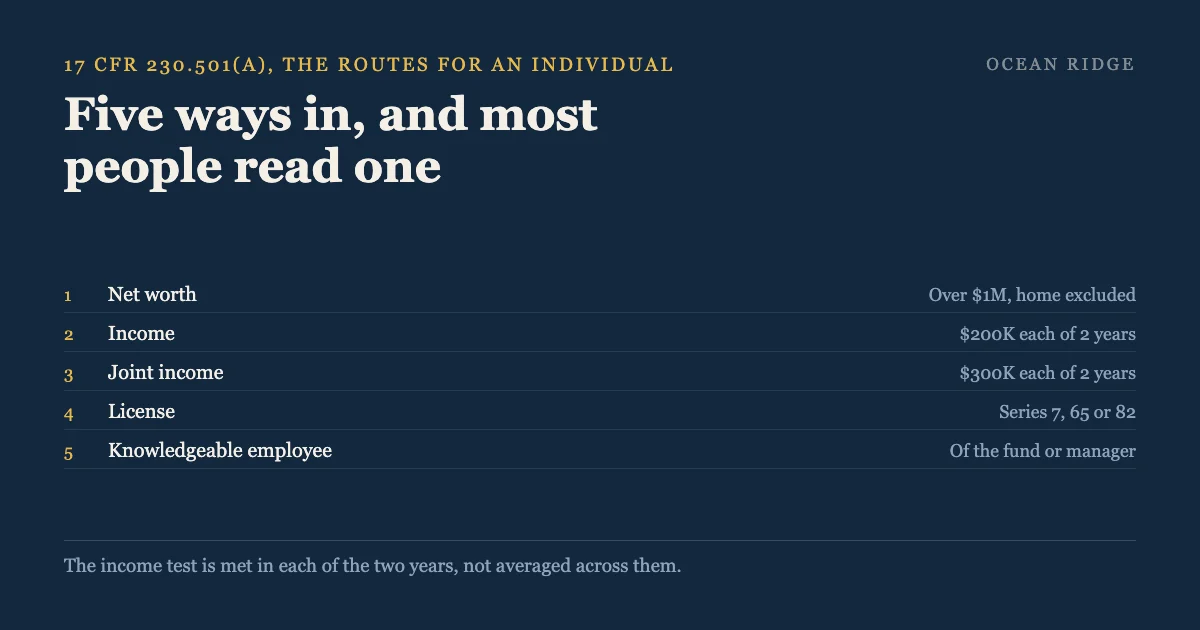
You qualify as an accredited investor on net worth if it is over $1 million, excluding your home.
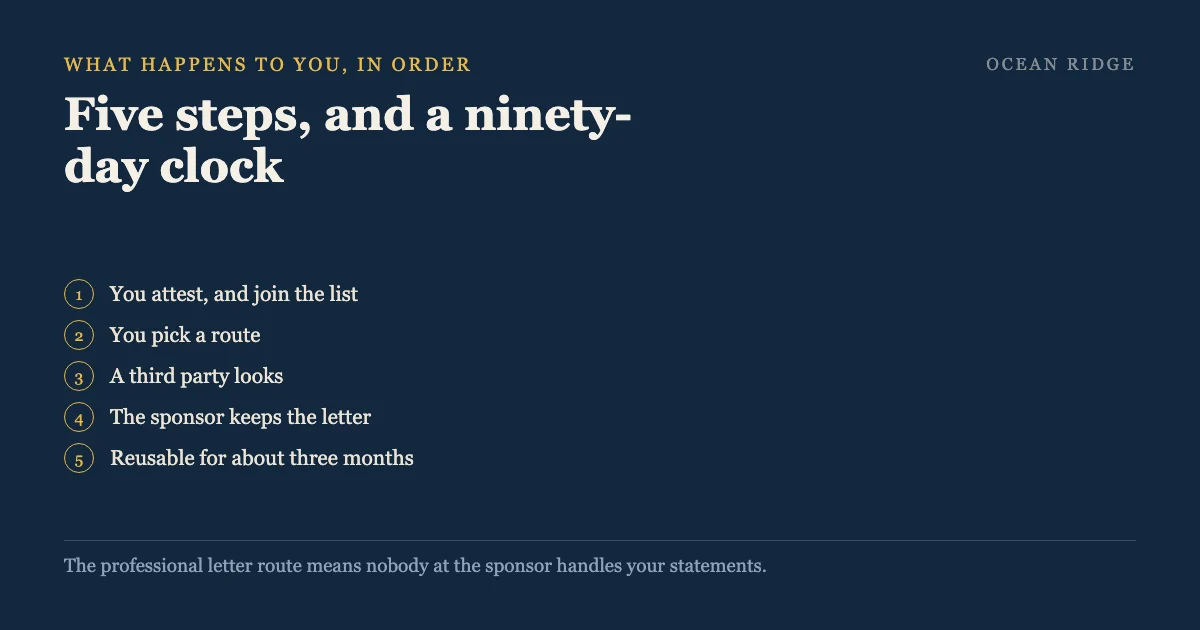
You self-attest to get on the list. At subscription, a third party verifies you are an accredited investor: a letter from your CPA, attorney, registered broker or adviser, or a verification service. A letter is generally good for about three months. Nobody at Ocean Ridge needs to see your tax return.
For educational purposes only. Nothing on this page is investment, legal or tax advice, and nothing here is an offer to buy or sell any security. Ocean Ridge Capital Partners, LLC is not a registered investment adviser, broker-dealer, law firm or accounting firm.
The worry underneath is how invasive this gets, and who ends up holding your financial papers. It is a fair worry. Somebody does have to look, because the sponsor carries a duty rather than a preference. But it does not have to be the sponsor. The paperwork is narrower than people expect. And the route you pick decides how much of your life anyone sees.
The requirement itself sits in Rule 506(c)(2)(ii), which sets out the non-exclusive methods a sponsor may use. Non-exclusive matters. The rule lists accepted methods, not the only permitted ones.
| Route | What you hand over | Who sees it |
|---|---|---|
| Professional letter | Nothing new. Your CPA, attorney, broker or adviser confirms in writing | Only the professional you already use |
| Income route | Two years of returns or W-2s, plus a written representation about this year | The verifier |
| Net worth route | Statements of assets and liabilities, plus a credit report | The verifier |
| License route | Your Series 7, 65 or 82 details, checked against the public register | Nobody. It is a public lookup |
| Existing verification | A letter obtained for another deal, if it is still inside the window | Already done |
The first route and the fourth ask the least of you. The letter route is the least invasive, because the person writing it already holds the information. A license lookup involves handing over nothing at all. The document routes exist for people with no professional relationship to call on.
There is also a route built on a large minimum commitment. Where the investment is big enough, and you state in writing that you are not borrowing to fund it, that has been treated as reasonable verification. It comes from staff guidance rather than from the text of the rule.
Private offerings are normally silent. The general solicitation ban in Rule 502(c) is the default. Rule 506(c) is the exemption that lets a sponsor talk in public, and verification is the price of it.
It protects you less than it protects everybody else in the deal. If verification is done badly, the exemption can fail. An offering that loses its exemption is a problem for every investor in it, not only for the one who was never checked. That is why a sponsor who waves this step through is a warning rather than a convenience.
One more reason to care. The record outlives the deal. The letter, and the note of what steps were taken, are kept for years. A thin file is a problem found later, usually by somebody else.
And it is worth knowing who carries the cost of getting it wrong. Not you. The investor who answered honestly is the one who ends up in a deal whose exemption is in doubt, through nobody's fault but the sponsor's.
Our view is that this step is a courtesy test. It is the first piece of administration you see from us, and how we handle it says something about the next five years. So we offer the letter route first wherever we can. It means nobody in our office handles your statements.
We also do not treat it as a formality. The duty is ours, not yours. A sponsor who cuts this corner puts a whole offering at risk to save an afternoon. If the verification is awkward, we would rather be slow than relaxed about it.
The one thing we ask in return is that the letter comes from somebody with a real professional relationship to you. A letter from a party who looked at nothing is worse than no letter. It creates a record that implies work nobody did.
None of this applies in a 506(b) offering. There is no verification duty there, and self-certification is the norm, which is also why those deals cannot be advertised. It does not apply to a Regulation A offering, which has its own limits and its own process. For an entity, a trust or a retirement account, the question is which test the entity itself meets. The paperwork then differs from the individual routes above.
Not if you use the professional letter route, which is the least invasive of the five. Your CPA, attorney, broker or adviser confirms your status in writing and we keep the letter rather than the underlying documents.
Reliance on a prior written verification generally runs for about three months, so one letter can cover more than one subscription inside that window.
Yes. Several exist and they work, for a fee you usually pay. We will not name one as a recommendation, because the choice should be yours.
Then the subscription cannot be accepted in a 506(c) offering. The duty is on the sponsor and there is no version of the step we can skip.
You do, if you use a paid service. A letter from a professional you already work with is usually covered by what you pay them anyway, so ask them first.
If you are weighing a deal this year, book an investor strategy call.
Published · Last reviewed
Next step
Not ready to talk? Take the investor quiz and we will send what fits.
Keep reading
How we investBuilding net worth
You qualify as an accredited investor on net worth if it is over $1 million, excluding your home.
Real estateBuilding net worth
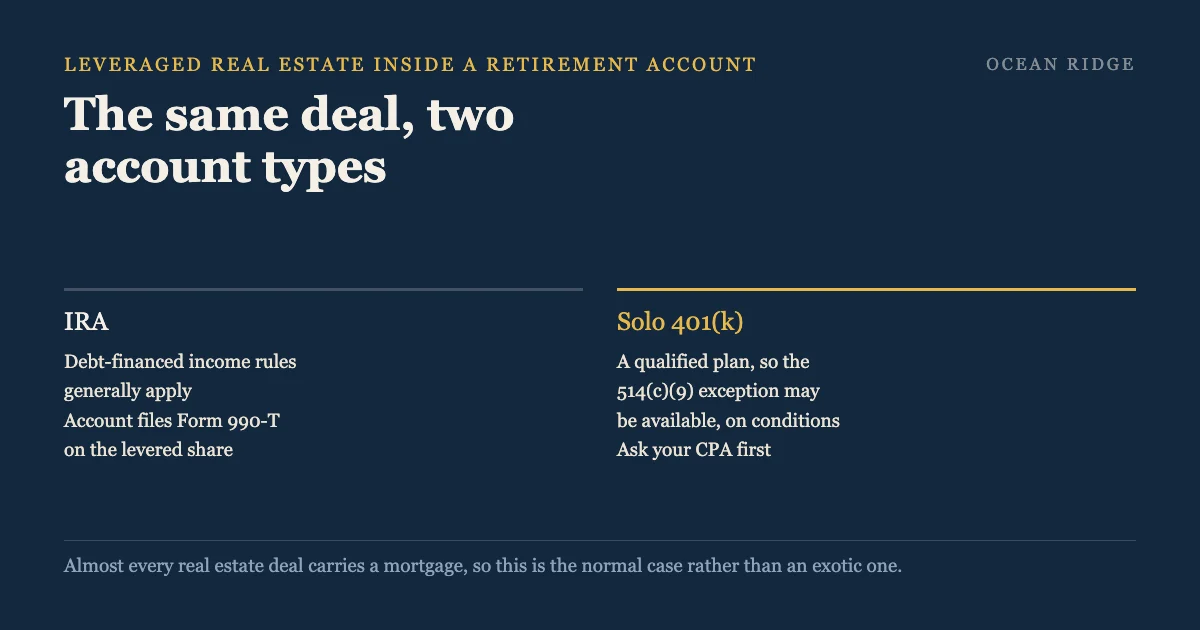
Yes, through a custodian that allows private placements.