
How we investBuilding net worth
How does Ocean Ridge get paid?
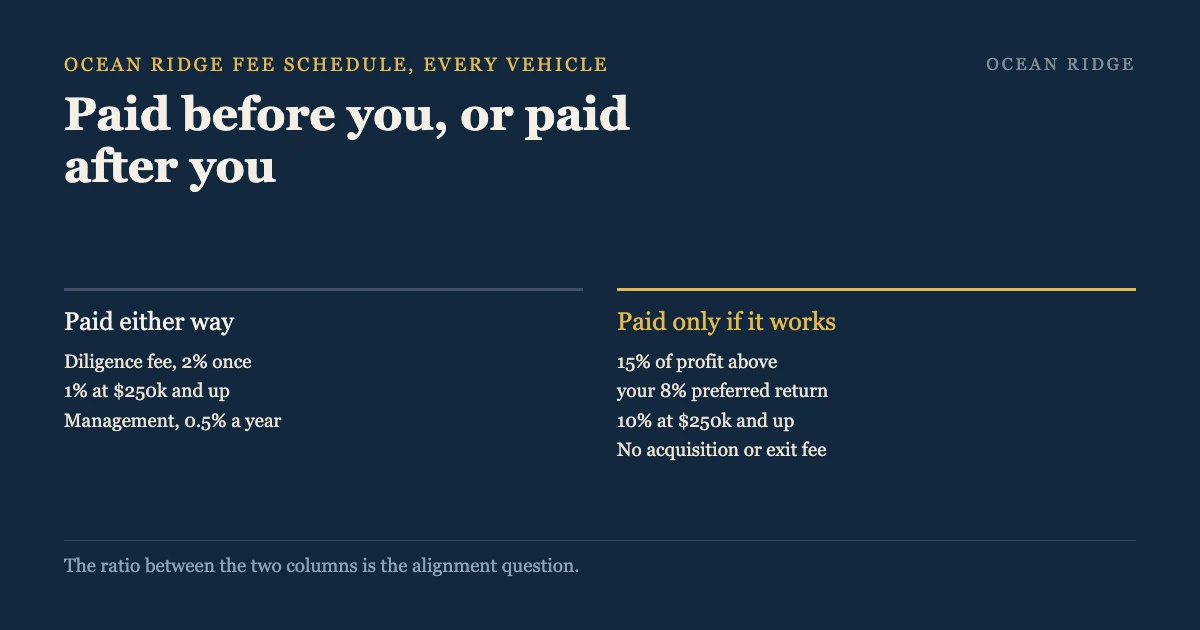
On our most recent equity vehicle, three ways.
Not if the vehicle is built right. There is a second layer of fees, and the bigger pooled check has to win better terms that more than cover it. In our underwriting, you have to come out at least even with a direct investor at your check size. If a deal cannot clear that bar, we do not offer it.
For educational purposes only. Nothing on this page is investment, legal or tax advice, and nothing here is an offer to buy or sell any security. Ocean Ridge Capital Partners, LLC is not a registered investment adviser, broker-dealer, law firm or accounting firm.
You are checking whether the middle layer earns its keep. As an owner, you know what a layer of management is worth when it adds nothing. A fund of funds should show you on one page what it costs, what it earns back, and how you come out against going direct. Here is ours.
These are the terms on our most recent equity vehicle. Each vehicle sets its own terms in its offering documents.
| Our layer, $100,000, five-year hold | When you pay it | Dollars |
|---|---|---|
| Diligence fee, 2% | Once, on top of your investment | $2,000 |
| Management fee, 0.5% a year | Every year | $2,500 |
| Our share of profit above your 8% preferred return, 15% | Only after you receive your preferred return | Depends on the deal |
| Acquisition, disposition, financing or construction fees | Not charged at our layer | $0 |
Your preferred return is the profit paid to you first, before we share in any upside. The fixed part of our layer is $4,500 over five years, about 0.9% a year. At $250,000 and up, the diligence fee drops to 1% and our profit share drops to 10%. The sponsor below us charges its own fees, and you get that full schedule before you commit.
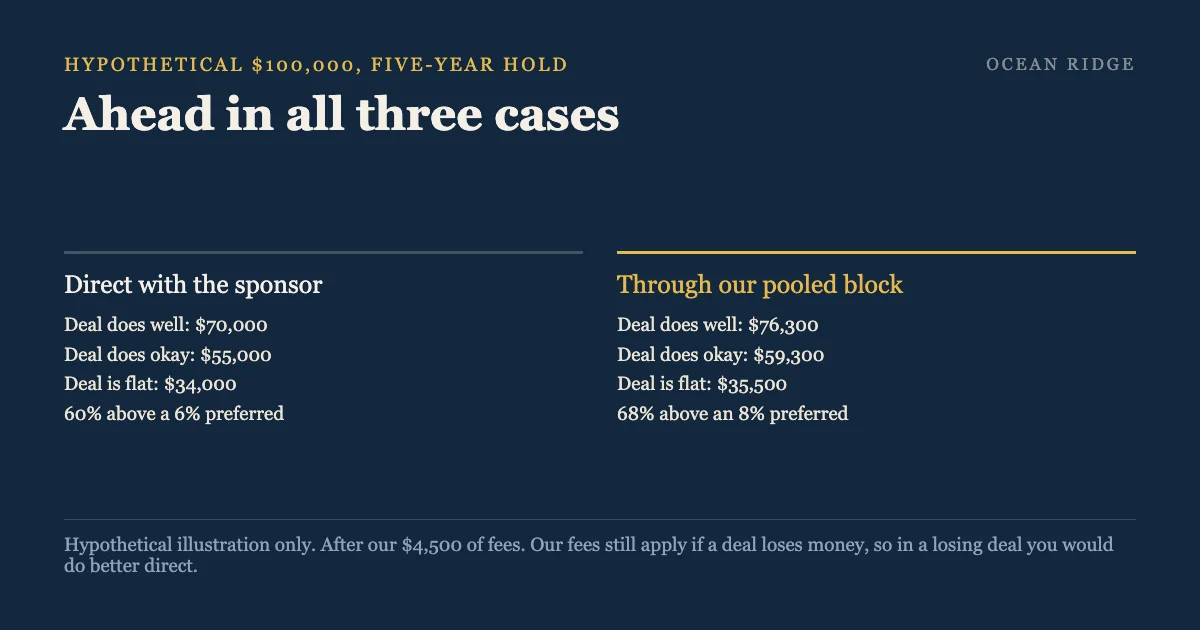
Sponsors often give bigger checks better terms. Pooled into one large check, our block can get a higher preferred return, a bigger share of profit, or a waived sponsor fee that $100,000 cannot get alone. Those better terms have to more than cover our fees. Here is a hypothetical, run three ways.
| Hypothetical, $100,000, five years | Direct with the sponsor | Through our pooled block |
|---|---|---|
| Terms | 60% of profit above a 6% preferred return | 80% above 8% to the block. You keep 85% of that, so 68% |
| Sponsor’s acquisition fee, your share | $2,000 | Waived for the block |
| Our diligence and management fees | None | $4,500 |
| Deal does well, earns $100,000 | $70,000 to you | $76,300 to you |
| Deal does okay, earns $75,000 | $55,000 to you | $59,300 to you |
| Deal is flat, earns $40,000 | $34,000 to you | $35,500 to you |
“Earns” means profit on your $100,000 before anyone takes a share. Preferred return is simple, not compounded, and assumed paid in full. Includes our fees and the sponsor’s acquisition fee. Other sponsor fees are assumed the same either way. Hypothetical illustration only. Not based on any actual investment and not a projection of future results.
Here the block comes out ahead in all three, by $1,500 in a flat deal and $6,300 when the deal does well. The waived fee and higher preferred return cover our fees, and better terms grow with the profit while our fees do not.
That is the test every vehicle we offer has to pass. When the pooled check cannot earn enough to cover our layer, we pass on the deal, however good it looks. Our fees still apply if a deal loses money, so in a losing deal you would do better direct. That is why we screen the deal before we negotiate the terms.
Under our rule, all of that comes on top of terms underwritten to be at least as good as going direct.
A fund of funds that cannot show you, in dollars, that you come out at least even with going direct is asking for trust on the one question that matters most. So we made it the rule for every vehicle we offer now, real estate and the income products planned for 2027.
After our fees, the terms have to leave you at least even with a direct investor at your check size, in both our base case and our conservative case. The better terms the pooled check earns are what pay for our layer.
Our rule compares you with what your check size gets going direct. If you can write a check big enough to get the sponsor’s best terms on your own, and you read offering documents for a living, going direct may serve you better. And a fair fee on a bad deal is still a bad deal, so judge the deal first and the fees second.
No. It is charged on top, so your full $100,000 goes into the deal. It is on the subscription agreement before you sign.
If your check is big enough to get the sponsor’s best terms alone, you might. Many sponsors save their best share classes for much larger checks, and some deals are closed to new direct investors. That gap is what the pooled check closes.
If you are weighing a deal this year, book an investor strategy call.
Published · Last reviewed
Next step
Not ready to talk? Take the investor quiz and we will send what fits.
Keep reading
How we investBuilding net worth
On our most recent equity vehicle, three ways.
How we investBuilding net worth
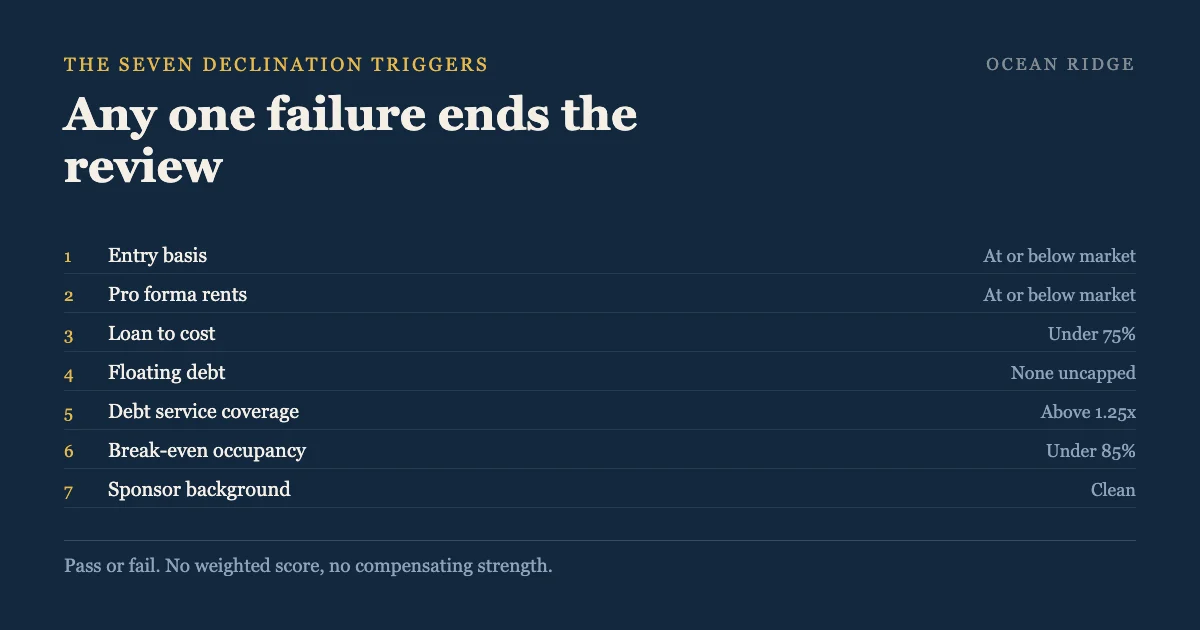
Declination triggers are seven pass/fail tests we run on every real estate equity deal before we spend a day on diligence.