
How we investBuilding net worth
What is an accredited investor and do I qualify to invest in real estate syndications?
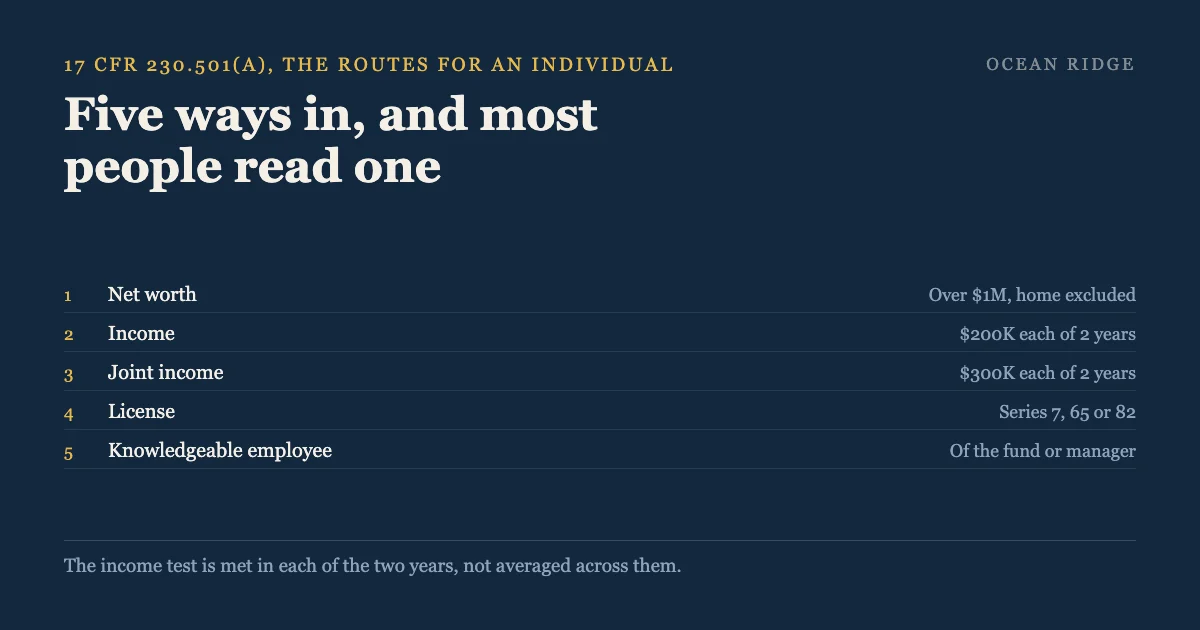
You qualify as an accredited investor on net worth if it is over $1 million, excluding your home.
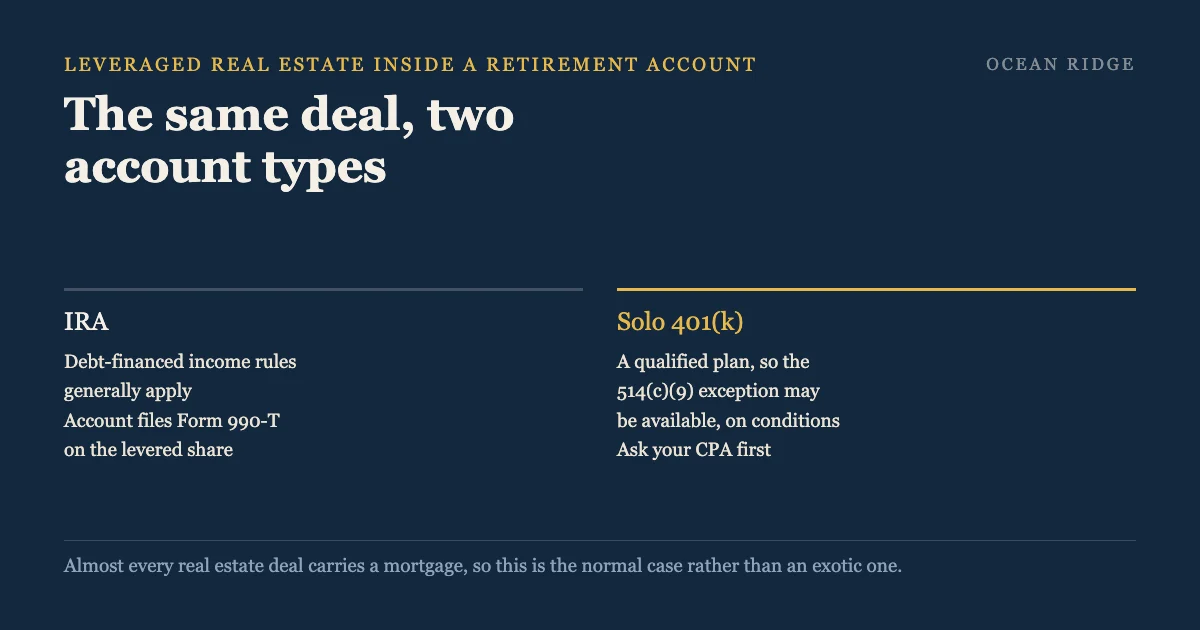
Yes, through a custodian that allows private placements. The catch sits one layer down. Most deals use a mortgage, and debt inside a retirement account can create a tax bill even though the account is otherwise exempt. And an IRA and a Solo 401(k) are not treated the same way on that point.
For educational purposes only. Nothing on this page is investment, legal or tax advice, and nothing here is an offer to buy or sell any security. Ocean Ridge Capital Partners, LLC is not a registered investment adviser, broker-dealer, law firm or accounting firm.
The question underneath is whether the money you actually have is usable. Most people with real capital hold it in a retirement account. Deals get quoted as though everybody has cash sitting idle. The answer is that the account can invest, although it needs a different custodian from the one you probably have. And two rules apply inside the account that do not apply outside it.
Allow two to four weeks for the first one. Custodian paperwork is the usual reason a subscription misses a closing date.
Retirement accounts do not usually pay tax on investment income. There is one exception that matters here. It is called unrelated business taxable income, and it sits in 26 U.S.C. 512. The version real estate investors meet is debt-financed income, under 26 U.S.C. 514. Where property is bought with borrowed money, part of the income and part of the gain on sale fall into that category, roughly in proportion to the debt.
Almost every real estate deal carries a mortgage. So this is the normal case, not an exotic one. IRS Publication 598 sets out how it works and how it is reported. The account files on Form 990-T rather than you.
Here is the part that gets missed. Section 514(c)(9) carves out certain qualified organizations. Qualified pension and profit-sharing plans are among them. Those may buy real property with debt without the debt-financed rules applying, subject to conditions. An IRA is not in that group. A Solo 401(k) is a qualified plan and may be. Some investors may, depending on their situation, find the amounts too small to bother with. Others find this one point decides which account they use. It is the most useful question to put to your CPA before wiring anything.
Prohibited transactions are the second trap. They sit in 26 U.S.C. 4975, and the penalty is severe. An IRA that engages in one can stop being an IRA, as of the first day of that year.
| Fine | Not fine |
|---|---|
| The account invests as a passive member | You or a disqualified person personally guarantee the debt |
| You direct the custodian to subscribe | You do work on the property, paid or unpaid |
| The account holds a minority interest | The account invests in an entity you or family control |
| Distributions return to the account | You use the asset personally in any way |
Disqualified persons include you and your spouse, your parents and grandparents, your children and grandchildren and their spouses, and any entity they control. Siblings are generally outside the definition, which surprises people in both directions.
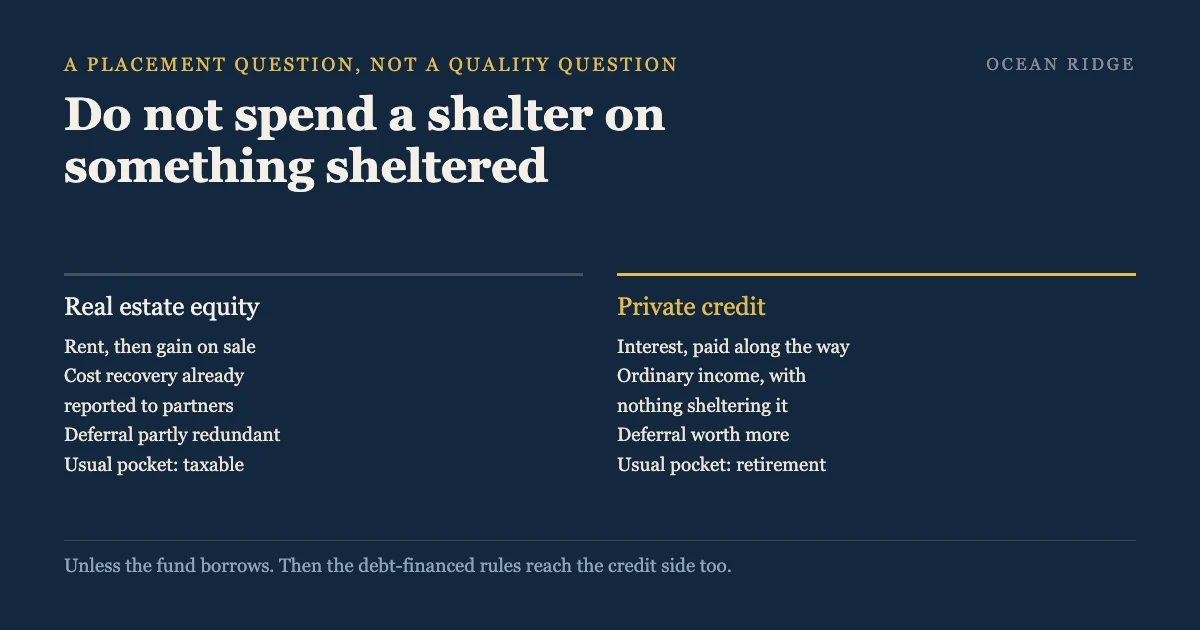
Our view is that a retirement account is a good home for a deal that pays income. It is a poor home for a deal whose return already arrives sheltered. An exempt account has nothing to apply cost recovery against. So half of what makes that deal attractive is wasted, and the debt rules can take back part of the rest.
So the first question is not whether the account may invest. It is which pocket this kind of deal usually sits in. That answer changes by deal and by person. It is a real question for your accountant, not for a web page.
Where we are firm is the paperwork. We would rather an investor spend three weeks opening the account properly than rush a subscription and create a problem. Mistakes inside these structures are expensive and hard to undo. Nothing here is tax, legal or investment advice, and the one professional who should see this first is your own.
None of this reaches an all-cash deal. With no borrowing there is no acquisition debt, so the debt-financed rules have nothing to work on. A Roth account follows the same rules inside, but what comes out of it is different, so the planning around it is not the same. And it does not apply to a plan at a current employer. Those generally cannot be moved or self-directed while you still work there.
Generally not. Holding a private placement requires a custodian that administers alternative assets, which is a different kind of account from a standard brokerage IRA.
Possibly, where the deal uses a mortgage. Income attributable to acquisition indebtedness is treated as unrelated business taxable income and the account itself files on Form 990-T. The amount is often small, and it is not always small.
We will not name one as a recommendation. Compare fees, how quickly they turn around subscription documents, and whether they have handled this type of asset before.
No. A personal guarantee by a disqualified person is a prohibited transaction, and in an IRA the consequence can be disqualification of the whole account.
Yes, and each account subscribes separately in its own name. Combining them into one subscription is where the ownership record gets muddled.
If you are weighing a deal this year, book an investor strategy call.
Published · Last reviewed
Next step
Not ready to talk? Take the investor quiz and we will send what fits.
Keep reading
How we investBuilding net worth
You qualify as an accredited investor on net worth if it is over $1 million, excluding your home.
Private creditPassive income
Often yes, and for one reason.