
How we investBuilding net worth
What does Ocean Ridge actually do?
We are investors, not a sponsor, not a broker and not an adviser.
It means our own money sits in the same position as yours, on the same terms, taking the same loss at the same time. The amount per deal is sized to what we can afford rather than to what would read well. Ask to see it in the documents rather than on a slide.
For educational purposes only. Nothing on this page is investment, legal or tax advice, and nothing here is an offer to buy or sell any security. Ocean Ridge Capital Partners, LLC is not a registered investment adviser, broker-dealer, law firm or accounting firm.
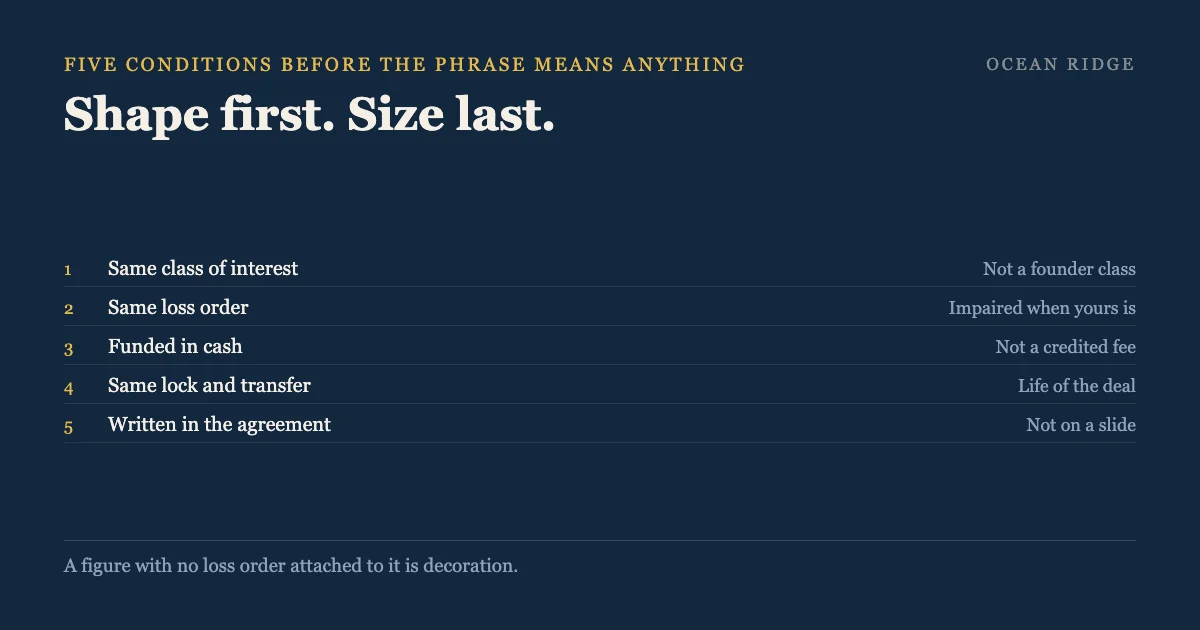
What you are really asking is whether a bad outcome costs us anything. Skin in the game is the most repeated phrase in private investing and the least examined. It can mean cash at risk beside yours. It can also mean a waived fee recorded as equity, a share class that gets paid back first, or a figure that is true of the firm and not of this deal. Those are different answers to the same sentence.
Five conditions. Any one of them missing changes what you are being told.
Statements made to prospective investors in a pooled vehicle sit under 17 CFR 275.206(4)-8, which makes materially misleading statements to them unlawful. So this is a question you are entitled to have answered precisely, and a vague answer is itself the answer.
Private offerings furnish information to purchasers under Rule 502(b), and whatever the minimum requirement, the practical rule is that you get what you ask for before you sign and very little afterwards. Ask before.
A large commitment from a firm that can easily afford it signals less than a smaller one that would genuinely hurt. The useful question is not how many dollars, it is what proportion of the money that person controls, and where in the waterfall it sits. A figure with no loss order attached to it is decoration.
There is a ceiling on this too. A manager who puts in so much that the vehicle is mostly their own money has a different problem: your interests are aligned, and your influence is nil. Somewhere between nothing and everything is the honest range, and the only way to judge it is to read the waterfall and the governance clause together.
One last test, and it costs nothing. Ask when the commitment was funded. A manager who wired at closing says so immediately. A manager who means to fund later, or out of fees as they are earned, takes a sentence or two to get there. The hesitation is the answer. It is not a disqualifier. It just tells you which kind of alongside you are being offered.
Our view is that co-investment is a constraint on us rather than a selling point for you. It is the reason a deal we are unsure about does not get done, because the first money at risk is ours. We would rather describe it that way than as a badge.
We size it to what we can genuinely afford on each deal rather than to a fixed percentage, and that means it moves. A number chosen to look consistent would be a marketing number, and the first bad quarter would expose it. We would rather tell you the real figure and explain why it was that figure on that deal.
What we will not do is count a waived fee as equity. If the money did not leave our account, it is not at risk, whatever the capital account says. That distinction is the whole reason the phrase is worth asking about.
This logic does not transfer to a sponsor who is also the operator. There the alignment often sits in the work rather than in the check: an operator earning fees for running the asset has income at stake whether or not their capital is in it, and that can be a stronger incentive than a small equity position. It also does not apply to a lender, where the alignment question is about recourse and collateral rather than about shared equity.
No. It is a reduction in what the manager takes out, which is worth something, but no cash was put at risk. Ask whether the commitment is funded in cash.
Ideally yes, and if not, the differences should be explained in writing. A separate class is not automatically unfair, but it changes who gets paid first when something goes wrong.
There is no threshold that settles it. What matters is whether the amount is material to the person committing it and whether it is impaired at the same moment yours is.
Often yes. Ask for the capital account statement or the closing funds flow after the deal closes. Firms that funded it have no reason to withhold that.
If you are weighing a deal this year, book an investor strategy call.
Published · Last reviewed
Next step
Not ready to talk? Take the investor quiz and we will send what fits.
Keep reading
How we investBuilding net worth
We are investors, not a sponsor, not a broker and not an adviser.
How we investBuilding net worth
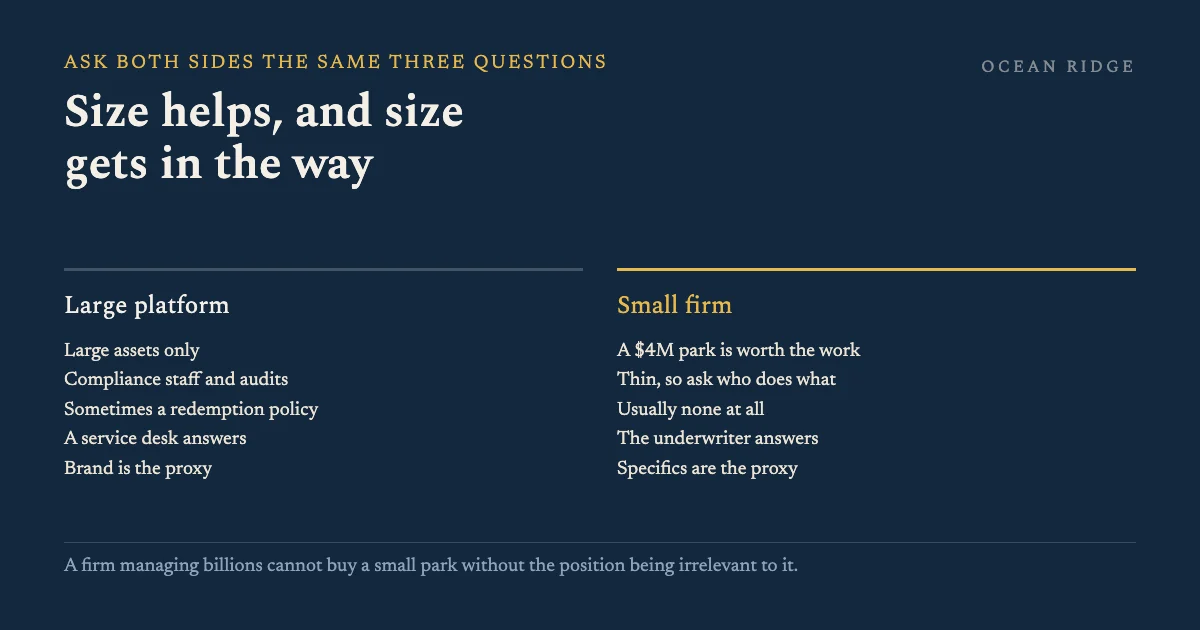
Do not trust either on the strength of the name.