
Private creditPassive income
What is private credit, and how is real estate credit different from corporate private credit?
You are the bank.
By the order you get paid when the property sells for less than everyone hoped, and by what you can seize if nobody pays. A 9% first lien can be better protected than a 15% second. The rate is the market telling you where in the queue you are standing.
For educational purposes only. Nothing on this page is investment, legal or tax advice, and nothing here is an offer to buy or sell any security. Ocean Ridge Capital Partners, LLC is not a registered investment adviser, broker-dealer, law firm or accounting firm.
Underneath this is a simple worry: if the deal goes wrong, what do I actually own. The answer is not a document. It is a position in a line, and the line is paid from the top down until the money runs out. Everything above you gets paid in full before you get a cent. Everything below you is already gone when your turn comes.
| Position | Secured by | What you can do if nobody pays |
|---|---|---|
| First lien | A mortgage on the property | Foreclose on the building itself. You are first in line |
| Second lien | The same property, behind the first | Foreclose, but only after the first is paid, and usually only when an intercreditor agreement lets you |
| Mezzanine | A pledge of the ownership interests, not the property | Take the equity under UCC Article 9, which is faster than foreclosure and leaves the first mortgage in place |
| Preferred equity | Nothing. You are an owner with priority | Exercise control rights. There is nothing to seize |
The jump from mezzanine to preferred equity is the one people miss. Mezzanine is debt with a remedy. Preferred equity is ownership with a better seat. It often pays a similar rate, and in a bad outcome it behaves nothing like its neighbour.
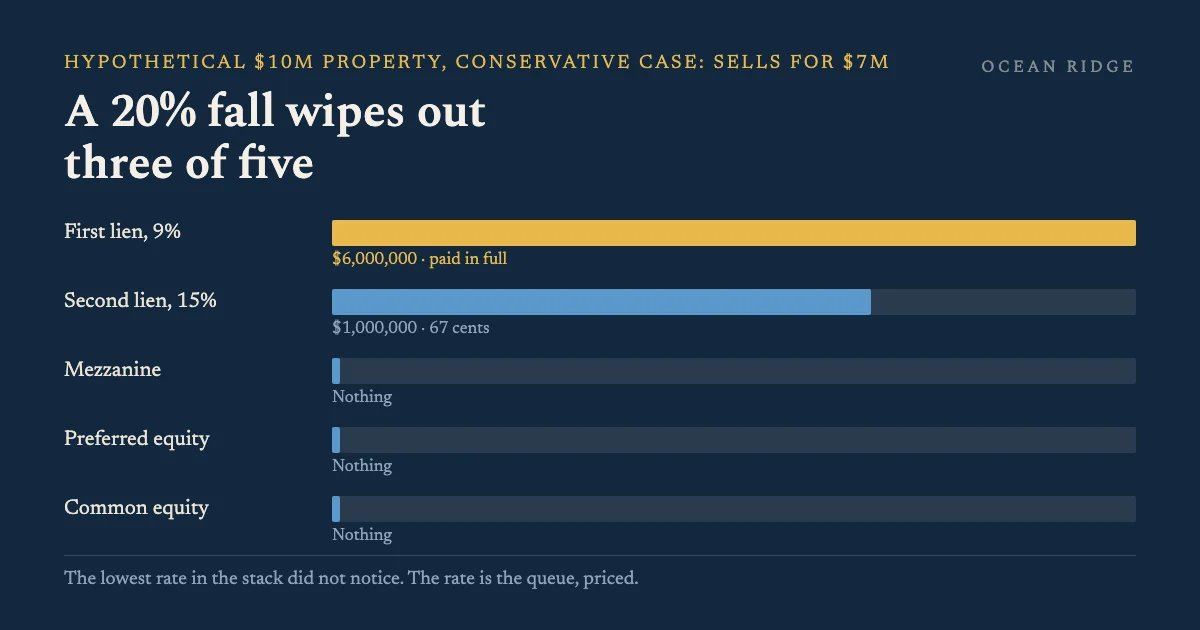
This is a hypothetical, not a deal and not a projection. The assumption is a property bought for ten million dollars, funded with a six million first lien at 9%, a one and a half million second at 15%, one million of mezzanine and a seven hundred and fifty thousand preferred equity piece, with the rest common equity.
| Who | Owed | Base case: sells for $9M | Conservative case: sells for $7M |
|---|---|---|---|
| First lien | $6,000,000 | Paid in full | Paid in full |
| Second lien | $1,500,000 | Paid in full | $1,000,000, so 67 cents |
| Mezzanine | $1,000,000 | Paid in full | Nothing |
| Preferred equity | $750,000 | $500,000 | Nothing |
| Common equity | The rest | Nothing | Nothing |
Read the conservative column. A two million dollar shortfall, which is twenty percent off the purchase price, wipes out three of the five positions and takes a third off the fourth. The first lien lender, on the lowest rate in the stack, does not notice.
That is the whole lesson. The 15% was not generous. It was priced for the column on the right.
In a capital stack the rate rises as the protection falls. That is not a bargain being offered to you, it is the market pricing the queue. So a higher number is information about risk before it is information about return.
Two questions get you most of the way. First, what has to be true for the position above me to be paid in full, and is that likely. Second, if I have a remedy, how long does using it take. An automatic stay under 11 U.S.C. 362 halts collection the moment a borrower files, and a remedy you cannot use for a year is worth less than the document suggests.
One last check, and it is arithmetic rather than judgment. Work out how far the value has to fall before your position is impaired, and say that number out loud. On the hypothetical above, the mezzanine piece is wiped out by a fall of roughly fifteen percent. If that number is smaller than the move the market made in any of the last three years, the rate is not compensation, it is a description.
Our view is that position matters more than rate, and that most investors have it the other way round. The rate is the first thing in the pitch and the last thing that decides the outcome. Where you sit in the stack decides whether you get any of it.
So we read the stack before the term sheet. How much is ahead of this position, what has to happen for that to be repaid, and what is the cushion underneath before the position is impaired. If the answer is that a fifteen percent fall in value wipes out the piece being offered, the rate is not the subject.
We also treat preferred equity as equity, whatever the pitch calls it. The word preferred does good work in a brochure and no work at all in a foreclosure. If there is nothing to seize, it is not lending, and it should be judged against equity returns rather than against credit ones.
None of this applies cleanly where the whole stack is held by one party, which happens on smaller deals and removes the intercreditor problem entirely. It does not apply to a loan with recourse to a creditworthy guarantor, where the collateral is only half the question. And it changes shape where the borrower is a single-purpose entity in a jurisdiction with a fast non-judicial foreclosure process, because the time cost of a remedy is a large part of what the position is worth.
Equity, with a priority on distributions. It usually has no lien and nothing to foreclose on, which is why it pays more than the debt above it.
The contract between lenders at different positions that sets who may act, when, and what the junior lender has to stand still for. For a second lien it is often more important than the loan documents.
Not the property. The ownership interests in the entity that holds it, under Article 9, which is usually faster than a mortgage foreclosure and leaves the senior mortgage untouched.
It means a worse position, priced. Whether it is a better deal depends on whether the cushion beneath you is thicker than the extra rate suggests.
Enough that a fall the market has actually produced in recent memory would not reach you. Work out the percentage drop that impairs your piece, then compare it to the last three years.
If you are weighing a deal this year, book an investor strategy call.
Published · Last reviewed
Next step
Not ready to talk? Take the investor quiz and we will send what fits.
Keep reading
Private creditPassive income
You are the bank.
Private creditPassive income
Defaults are normal.