
Private creditPassive income
How does Ocean Ridge evaluate a private credit fund?
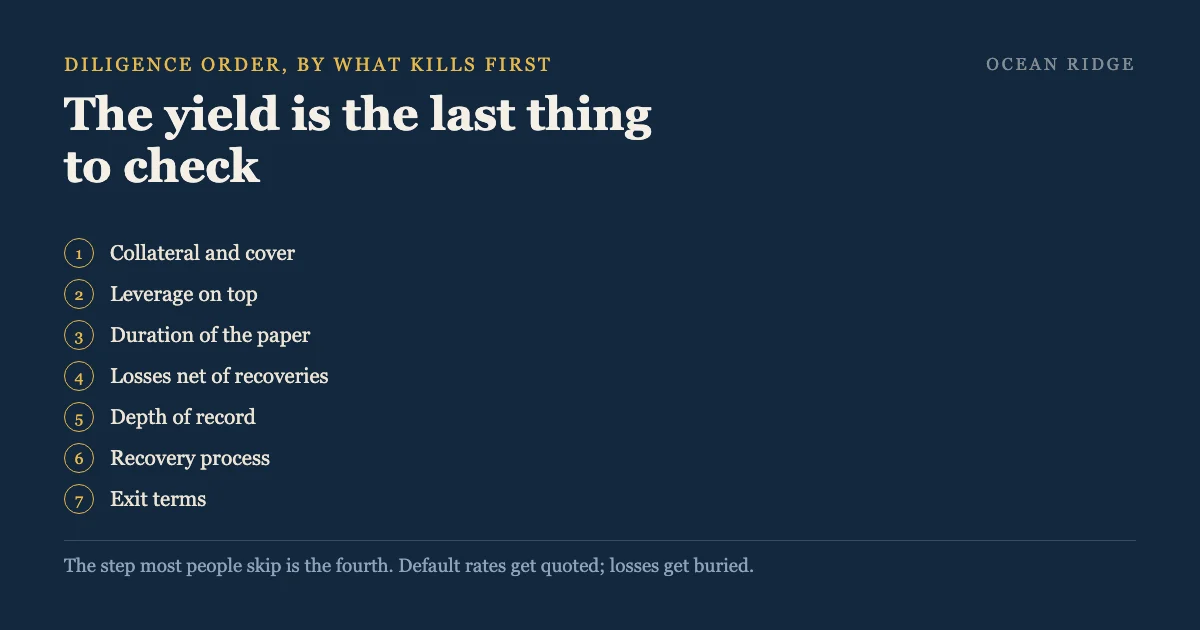
We set the headline yield aside, because they all quote about the same number.
Defaults are normal. Losses are a different number, and the gap between the two is the manager’s actual job. What matters is how much comes back, how long it takes, and whether the book is marked honestly while you wait. A fund reporting no losses ever is making a claim about its marks.
For educational purposes only. Nothing on this page is investment, legal or tax advice, and nothing here is an offer to buy or sell any security. Ocean Ridge Capital Partners, LLC is not a registered investment adviser, broker-dealer, law firm or accounting firm.
You are asking to be shown the downside, and you are right to be suspicious of how rarely it gets shown. Every credit pitch is a yield and a track record. Almost none of them walk you through what happens on the day a borrower stops paying, which is the only part that decides whether the yield was real. The question is not whether defaults happen. It is what the manager does in the eighteen months after one.
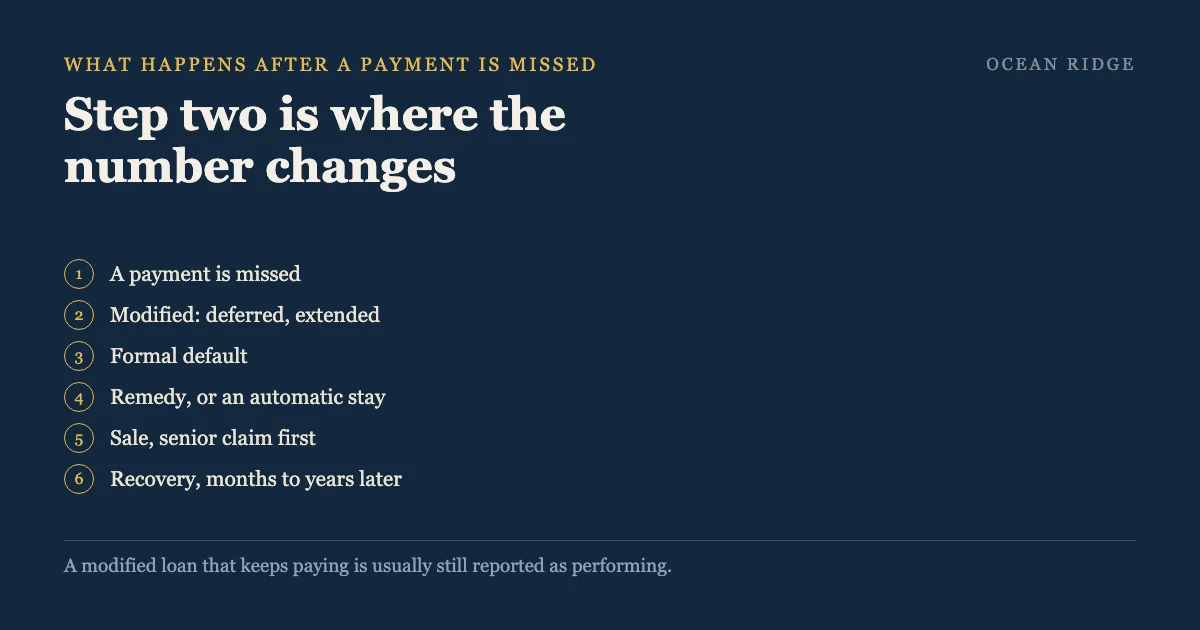
Step two is the one to watch. A modified loan that keeps paying under new terms often still counts as performing, and that is how a book with real trouble in it reports a clean default rate.
| Number | What it says | What it hides |
|---|---|---|
| Default rate | How many borrowers stopped paying | Modifications, extensions and deferrals that kept a loan nominally current |
| Recovery rate | How many cents came back per dollar | How long it took, and what the money could have earned meanwhile |
| Net loss rate | What you actually lost after recoveries and costs | Nothing much. This is the one to ask for |
Commercial real estate lending has a public series you can hold a manager against: the Federal Reserve publishes the delinquency rate on commercial real estate loans at all commercial banks quarterly. A fund whose own experience through the same window looks nothing like the system’s is either genuinely better or marking differently, and the question is which.
It is not a lie, usually. It is a sentence doing a lot of work. Six questions take it apart.
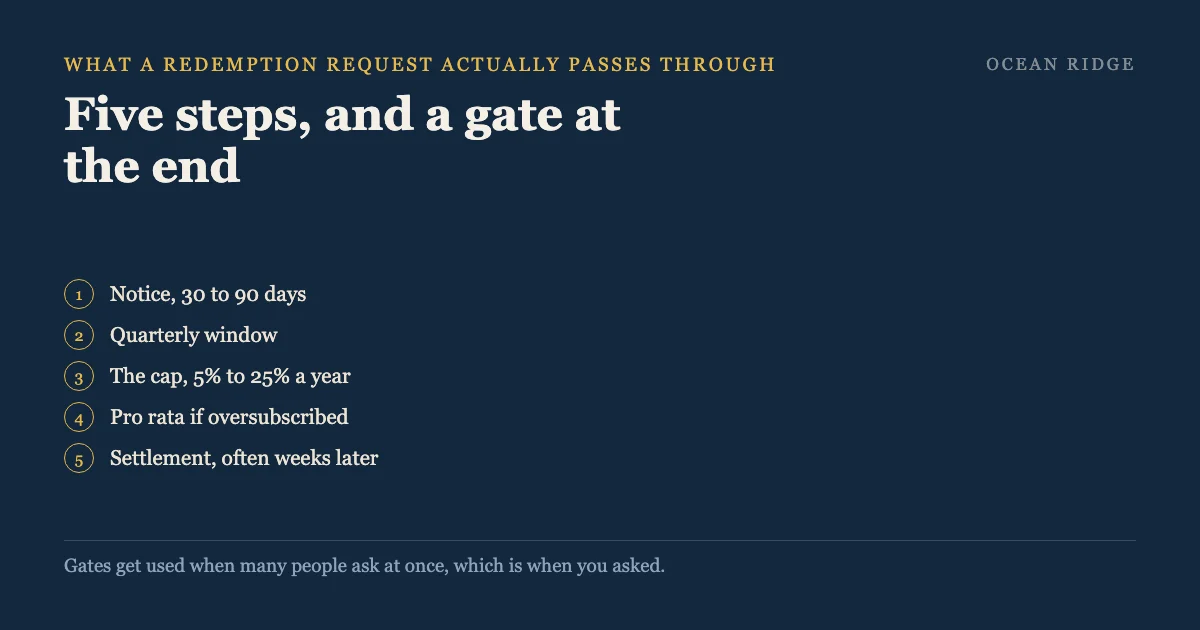
The Fed’s Financial Stability Report for May 2026 is worth reading alongside those, because it records nontraded vehicles facing rising redemption requests on asset-quality concerns and limiting redemptions in response. Marks and liquidity fail together, which is why a question about one is a question about the other.
One last question, and it is the one that catches people. Ask what share of the book is currently in a workout, not what share defaulted historically. The first is a fact about today that somebody has to look up. The second is a story about the past that has already been rehearsed.
Our view is that a credit manager is bought for the workout, not for the yield. Anybody can originate at a good rate in a good year. What you are paying for is judgment on the day a borrower calls with bad news, and that judgment only shows up in a cycle.
So we would rather see a manager who has taken losses and can describe them precisely than one with an unblemished record and a short history. The first has been tested. The second has been lucky, or is newer than the pitch implies, and we cannot tell which from the outside.
The marks are the other half. A book nobody independent has looked at is a book of opinions. We ask who marks it, how often, and what happened the last time an outside party disagreed. The answer to that last question is usually the most informative sentence in the meeting.
None of this applies in the same way to very short duration lending, where loans mature before trouble has time to develop and the portfolio turns over faster than a workout takes. It does not apply to a fund whose loans all carry a creditworthy guarantor, where the analysis moves to that guarantor. And it reads differently for a fund in wind-down, where recoveries are the entire remaining business and there is no new origination to average them against.
No, and the gap between them is the point. A default is a missed payment. A loss is what does not come back after the collateral is sold and the costs are paid.
Months at best, years where a borrower files and an automatic stay halts collection. Time is itself a cost, because the money earns nothing while the process runs.
It depends entirely on position and collateral, and a manager quoting one number across a whole book is averaging things that should not be averaged. Ask for it by position.
You often cannot from outside, which is why the questions are about process: who marks, how often, who checks, and what happened when somebody disagreed.
Sometimes in the fund’s own reporting, often only if you ask. A loan modified and still paying is usually reported as performing, which is accurate and incomplete.
If you are weighing a deal this year, book an investor strategy call.
Published · Last reviewed
Next step
Not ready to talk? Take the investor quiz and we will send what fits.
Keep reading
Private creditPassive income
We set the headline yield aside, because they all quote about the same number.
Private creditPassive income
Usually more liquid than real estate.